
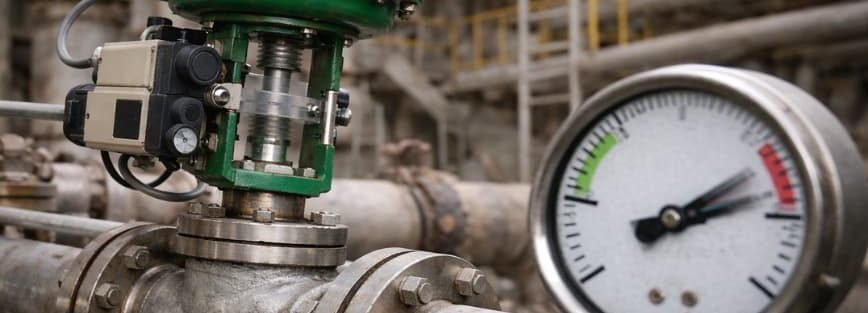
In many heavy process industries, control valves fail to maintain a steady position, constantly oscillating and causing production losses, equipment wear, and operational disruptions. The control valve hunting problem is a critical issue that can impact process efficiency and safety. Understanding its causes, diagnosing it accurately, and implementing effective preventive measures is essential for engineers and maintenance teams to ensure smooth and reliable operations.
Why Does a Control Valve Hunting Problem Occur During Steady Load?
A control valve hunting problem occurs during steady load conditions when the valve fails to stabilize at its required setpoint, constantly oscillating instead of holding a fixed position. Even when the process demand is stable, this internal instability can cause disruptions and equipment wear. Understanding why this happens is essential, as it is typically triggered by one of the following factors:
Main Causes of Control Valve Hunting:
- Controller Issues: Improper PID tuning can lead to aggressive or delayed responses, triggering oscillations.
- Actuator and Valve Problems: Oversized valves, stiction, defective seats, or insufficient actuator force contribute to hunting.
- Air Supply Variations: Pneumatic actuators with unstable or insufficient air supply respond poorly to control signals.
- Process Dynamics: Cavitation, turbulence, or mechanical resonance can amplify valve oscillations.
- Incorrect Valve Sizing: Valves too large or too small for the application can destabilize the control loop.
Troubleshooting and Preventive Measures:
- Verify and optimize PID controller settings.
- Inspect valve and actuator for wear, damage, and lubrication.
- Ensure steady air supply for pneumatic actuators.
- Monitor and address process disturbances such as cavitation or turbulence.
- Check valve sizing for correct application fit.
- Calibrate and service positioners to maintain accurate control.
- Implement dead band or hysteresis to reduce oscillations.
- Establish routine maintenance to prevent unexpected failures.
Consequences of Valve Hunting:
- Reduced Process Efficiency: Constant valve movement wastes energy and lowers performance.
- Equipment Damage: Accelerated wear on actuators, seals, and valve components.
- Process Instability: Fluctuating temperature, pressure, and flow can disrupt operations and pose safety risks.
- Higher Maintenance Costs: Frequent repairs and part replacements increase operational expenses.
Main causes of valve hunting in cement plants
The main cause of valve hunting in cement plants is faults in the control loop, mainly incorrect controller tuning and internal valve issues.
- Inaccurate Controller Adjustment: High controller gain can cause excessive response to process changes, leading to oscillation and overshoot around the setpoint.
- Damaged Valve Trims: Worn or damaged trims can prevent the valve from closing properly, resulting in instability.
- Leakage: Leakage in gland packing or the actuator can cause sudden position changes, forcing continuous positioner correction and leading to hunting.
- Stiction: Static friction in the valve stem or internal components can cause stick–slip behavior, resulting in oscillations.
- Non-linear Processes: Irregular relationships between control signal and valve position increase susceptibility to hunting.
- Incorrect Valve Sizing: Although not the primary cause, improper sizing can worsen hunting behavior.

How to Diagnose Control Valve Hunting in the Field Without Advanced Tools
Even without advanced instruments, you can detect control valve hunting by observing the valve and process behavior:
- Watch the Valve Movement: Rapid or continuous oscillation around a setpoint indicates hunting.
- Monitor the Process Variable: Check for fluctuating pressure, flow, or temperature that mirrors the valve’s motion.
- Listen and Feel:
Unusual noises, vibrations, or jerky actuator movement can signal stiction or loop issues. - Check Manual Overrides: Temporarily operate the valve manually to see if the movement stabilizes—if it does, the issue may be in the control loop.
- Simple Trend Logging: Even a notebook or basic SCADA screen can help you spot patterns of oscillation over time.
How does actuator stiction or hysteresis trigger hunting behavior?
Actuator stiction and hysteresis are common causes of control valve hunting.
- Stiction (Static Friction): When the valve stem or actuator resists small movements, the valve stays “stuck” until enough force is applied. Once it breaks free, it may overshoot the setpoint, causing oscillations.
- Hysteresis: If the valve’s response depends on whether it’s opening or closing, small control signal changes can produce delayed or uneven movement. This mismatch between signal and position amplifies hunting.
Impact of Bad Feedback or Positioner Calibration
Incorrect feedback or poorly calibrated positioners can significantly contribute to control valve hunting.
- Bad Feedback: If the control system receives inaccurate signals about the valve position or process variable, it may overcorrect or under correct, causing oscillations.
- Positioner Calibration Issues: A miscalibrated positioner can respond too aggressively or too slowly to control signals, leading to unstable valve movement.
How to Prevent Valve Hunting with Proper Setup
Proper setup and tuning can minimize control valve hunting and maintain stable process control.
- Optimize PID Settings: Correctly tune proportional, integral, and derivative parameters to avoid overreaction to process changes.
- Ensure Actuator and Valve Compatibility: Select actuators with sufficient force and valves sized appropriately for the application.
- Calibrate Positioners Accurately: Regularly check and adjust positioners to ensure precise valve response.
- Implement Dead Band or Hysteresis: Small intentional gaps in the control loop reduce continuous oscillations around the setpoint.
- Address Process Disturbances: Minimize turbulence, cavitation, and other instabilities that can trigger hunting.
When Should a Control Valve Be Replaced?
A control valve should be replaced when repair is no longer cost-effective or the valve cannot maintain stable operation.
- Excessive Wear or Damage: Severe damage to trims, seats, or the actuator that cannot be fixed by maintenance may require replacement.
- Frequent Failures: Valves that repeatedly fail or cause process disruptions despite proper maintenance indicate end-of-life.
- Obsolete or Incompatible Equipment:
Older valves that no longer meet process requirements or cannot be calibrated accurately should be replaced. - Safety Concerns: If a valve poses a risk to personnel or equipment due to leaks, erratic operation, or inability to hold setpoints, replacement is necessary.
Struggling with Control Valve Hunting in Your Plant?
Control valve hunting can disrupt operations, reduce efficiency, and increase maintenance costs. RETQAN offers expert solutions, including field diagnosis, actuator tuning, positioner calibration, and preventive maintenance. With our support, your control loops stay stable, equipment lasts longer, and your plant runs reliably.
FAQs
How to tell if control valve hunting is caused by the process or the valve itself?
If the valve continues to hunt with a constant input, the issue is most likely with the valve itself.
Can cavitation or flashing contribute to valve hunting?
Indeed, control valve hunting can be facilitated by both cavitation and flashing.
Can control valve hunting damage the actuator or valve over time?
Indeed, over time, control valve hunting—the fast oscillation of a valve between its open and closed positions—can seriously harm the actuator as well as the valve.