

Control valves are the backbone of industrial systems, and even minor issues can trigger unexpected downtime, efficiency losses, and soaring maintenance costs. Understanding common control valve problems and solutions is crucial for maintenance teams and engineers to spot issues early, prevent costly failures, and keep operations running smoothly.
Common Control Valve Problems and Solutions
Below are common control valve problems and solutions seen in industrial plants, along with practical fixes :
- Adhesive / Sticking: Friction, wear, or debris accumulation can cause valves to stick, impairing control and movement.
- Leakage: Fluid leaking through packing or valve body might result in decreased control and possible safety risks.
- Erosion: High-velocity flow can degrade valve components, lowering their lifespan and function, particularly when combined with abrasive materials.
- Cavitation: Damage and noise may result from vapor bubbles forming and collapsing quickly in the fluid stream.
- Sound / Noise: Cavitation, high fluid velocity, or incorrect valve trim can produce excessive noise, affecting operations and worker comfort.
- Incorrect Alignment: Misaligned valves may cause uneven wear and reduced performance.
- Contamination / Debris: Foreign elements obstructing valve movement and sealing can impact control.
- Corrosion of Chemicals: Materials used in valves might deteriorate due to corrosive compounds present in industrial processes.
Remedies and Preventive Actions:
- Appropriate Size: Choose valves correctly sized for system flow rates and pressures.
- Material Selection: Use materials resistant to high pressures, temperatures, and corrosive substances.
- Reducing Noise: Install noise-reducing equipment such as attenuators or silencers.
- Positioner and Actuator Maintenance: Ensure actuators and positioners are properly sized and maintained to supply sufficient force for valve movement.
Case Study – Cement Kilns: In cement plants, high-temperature and abrasive flows increase the risk of sticking, erosion, and cavitation. Applying the above preventive measures significantly improves valve reliability and reduces downtime.
Understanding Control Valve Hunting Issues
Valve oscillation, or control valve hunting, occurs when a valve fluctuates around its setpoint instead of maintaining a steady position. This can be caused by issues in the control loop, mechanical factors, or process variations.
Read about the pre-commissioning checklist for instrumentation
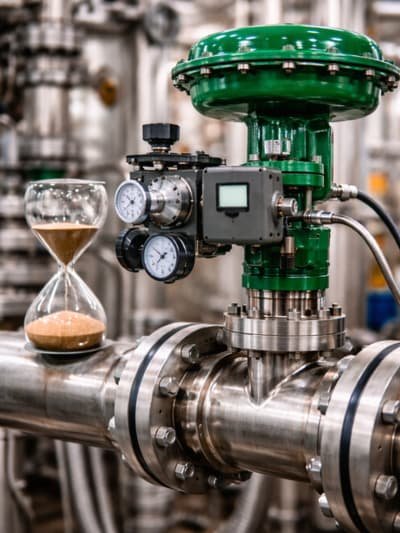
Slow Response in Pneumatic Control Valves: Causes
Slow response time in pneumatic control valves can affect operations and needs quick diagnosis.
Air Supply Problems
- Contaminated or Clogged Air: Dirt, moisture, and other impurities can enter the air supply, limiting airflow and slowing movement.
- Corrosion: Can damage seals and impair performance.
- Seal Degradation: Weakened seals reduce pressure, slowing actuator response.
Actuator Problems
- Sizing Issues: An actuator too small cannot provide sufficient force; oversized parts may slow response due to inertia.
- Damaged or Worn Diaphragms: Leads to leaks and reduced actuator force.
- Binding or Sticking: Dirt, debris, or corrosion can impede smooth movement.
Additional Contributing Factors
- Friction, Malfunctioning Positioners, Environmental Effects: Vibration or temperature variations can affect mechanical stability, leading to slower or inconsistent valve movement.
Why Is the Control Valve Leaking Even When Fully Closed?
A control valve may leak even when fully closed due to several underlying causes:
- Worn or damaged seats, along with aging or degraded seals/packing, can prevent a complete seal.
- Foreign particles trapped between the valve plug and seat can allow fluid to pass.
- Misalignment or stress from temperature/pressure changes can leave small gaps, allowing leakage.
Understanding these causes helps engineers identify the source of leakage and take corrective action before it impacts system performance.
How Do I Detect Seat Leakage Without Removing the Valve?
Detecting seat leakage without disassembling the valve saves time and avoids unnecessary downtime. Here are practical methods used in industrial systems:
- Visual Inspection: Check for drips, stains, or fluid accumulation around the valve body, and look for unusual condensation or residue on downstream piping.
- Pressure Monitoring: Compare upstream and downstream pressures; a pressure drop when the valve is closed can indicate leakage.
- Flow Measurement: Use flow meters to detect unintended flow through a closed valve. Even small flow rates may signal seat leakage.
- Acoustic or Ultrasonic Testing: Specialized instruments can detect hissing or vibrations caused by fluid passing through tight gaps.
- Chemical or Dye Testing: Introduce a harmless tracer or dye into the system and check for leaks downstream.
What Are Common Causes of Control Valve Trim Damage in High-Temperature Lines?
- Thermal Expansion: Rapid temperature changes can expand or contract valve components unevenly, causing stress and misalignment of the trim parts.
- High-Velocity Flow and Cavitation: High-speed fluids, especially if carrying abrasive particles, and cavitation can wear down the valve plug, seat, and cage over time.
- Improper Material Selection: Using trim materials not rated for high temperatures or corrosive environments accelerates wear and failure.
Preventive Measures:
- Select trim materials resistant to heat, corrosion, and erosion.
- Ensure proper system design to reduce high-velocity and cavitation risks.
- Perform regular inspections and maintenance to detect early wear and prevent catastrophic failure.
Why Do Actuator Diaphragms Fail Frequently in Hot Environments?
Actuator diaphragms often fail in hot environments due to:
- Thermal and Chemical Damage: Thermal degradation and exposure to chemicals or steam can damage diaphragm materials.
- Aging and Fatigue: Continuous cycling reduces flexibility and strength.
- Overpressure: Sudden spikes can overstretch or rupture the diaphragm
Electrical vs Mechanical: How to Diagnose Control Valve Failures Accurately
Accurate diagnosis of control valve failures requires distinguishing between electrical and mechanical issues:
- Electrical Issues: Electrical issues such as faulty positioners, solenoids, or sensors can prevent proper valve movement; check wiring, signal input, and actuator response using diagnostic tools.
- Mechanical Issues: Mechanical problems, including sticking stems, worn seats, or damaged trim, can obstruct valve operation; inspect internals for wear, corrosion, debris, and ensure proper lubrication and alignment.
Need Expert Help with Industrial Control Valve Issues?
In industrial operations, having a reliable partner for control valve services can make a significant difference in minimizing downtime and ensuring system efficiency. RETQAN provides hands-on expertise in valve installation, maintenance, and troubleshooting, supporting engineers and maintenance teams to keep processes running smoothly.
FAQs
When should a control valve be rebuilt instead of replaced?
Rebuilding a control valve is preferable to replacing it when the cost of repair is much lower than that of a new valve and the valve is not too old or severely damaged.
How often should control valves be inspected in high-temperature lines?
Control valves in high-temperature lines should be tested at least every six months, and sometimes more regularly (quarterly, for example).
Why is my control valve not achieving full stroke during operation?
Numerous difficulties, such as actuator malfunctions, positioner malfunctions, internal valve sticking, or external variables like pressure or flow limits, might prevent a control valve from achieving full stroke.