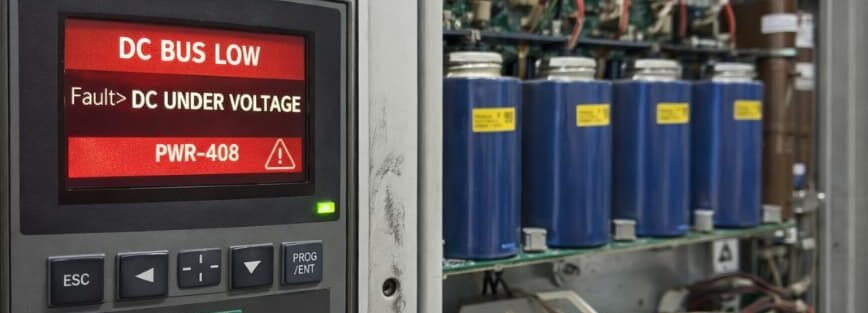
Did you know what DC under voltage in VFD is? It happens when the inverter’s DC voltage drops below the required threshold, potentially causing trips, reduced motor performance, and unexpected downtime. Maintaining a steady DC bus voltage is essential for proper drive operation.
What is DC under voltage in VFD?
Instead of relying solely on the input AC voltage, VFD under voltage protection for ordinary low HP drives uses the measured voltage on the DC bus. Understanding this is essential for troubleshooting.
A DC link under voltage fault can occur whenever something lowers the DC bus voltage. Use this tutorial to learn about DC under voltage in VFD and diagnose low DC voltage and VFD issues with under voltage fault codes.
Why does a VFD show DC undervoltage while the AC input voltage is normal?
A VFD can show a DC undervoltage fault even when the AC input voltage appears normal because the drive monitors the DC bus voltage, not just the AC supply. Any factor that reduces the DC bus voltage such as aging capacitors, sudden load changes, or insufficient rectifier performance can trigger the fault. Understanding this helps operators troubleshoot VFD trips effectively and prevent unexpected motor or production issues.
Read About: VFD installation requirements
What does undervoltage do to a motor?
If a VFD experiences DC undervoltage, the connected motor can face reduced efficiency, overheating, or even permanent damage risks that may lead to production delays or unexpected downtime. To prevent these issues, undervoltage protection ensures motors operate at the correct voltage, maintaining performance, reliability, and overall operational efficiency.
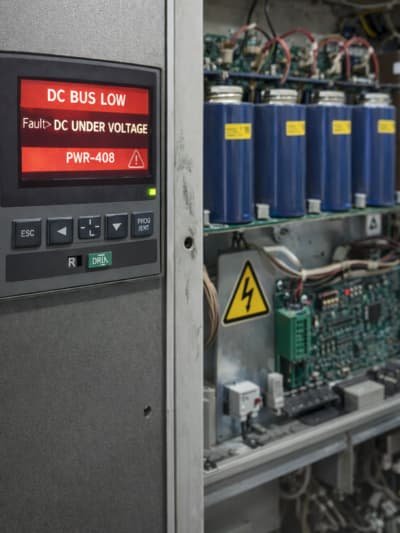
What causes a DC bus under voltage fault in a VFD?
DC bus undervoltage faults can happen due to several conditions. Understanding these helps troubleshoot effectively.
- Steady-State Undervoltage
Occurs when the facility bus voltage is below nominal. The DC bus voltage drops proportionally, and ripple increases. If voltage falls below the threshold, the drive trips. - Momentary Voltage Sag (Dip)
According to IEEE Std 1159, a voltage dip is an RMS voltage drop lasting more than ½ cycle but less than a minute, between 10% and 90% of nominal.Brief sags can cause:
– Primary impact: DC under voltage fault – Secondary impacts: circuit breaker/fuse trips, rectifier diode or capacitor failure
- Single-Phase Loss
May occur due to storms, blown fuses, or in single-phased facilities.
If the drive continues on two healthy phases:
- Peak currents increase
- DC bus ripple rises → may damage rectifiers/capacitors
Note: Disabling phase loss protection is not recommended.
- Pre-Charge Circuit Issues
Pre-charge relays with series resistors limit inrush current at startup.
If the contactor fails to bypass the resistor:
- DC bus voltage stays low → under voltage trip
- Repeated restarts can cause resistor failure
- DC Voltage Sensing Circuit Problems
Drive control monitors DC bus voltage to set undervoltage/overvoltage thresholds.
Any malfunction can cause nuisance trips, even if the DC voltage is within limits
Symptoms of DC Undervoltage in VFD Systems
DC undervoltage in a VFD can lead to several noticeable symptoms that affect motor performance and drive operation:
- Motor Overload Trips: The frequency inverter may trip when the motor draws excessive current due to a jammed or overly heavy load.
- Incorrect Parameter Settings:If acceleration or deceleration timings are too tight, the drive may try to supply more current than it is designed for, triggering trips.
- Unbalanced Voltage or Load:Mismatched phase voltages can cause the motor to draw unequal current, activating overload protection.
- Ambient Conditions: High ambient temperatures or limited airflow can lead to VFD overheating and overload shutdowns.
How to Check and Monitor DC Bus Voltage on a VFD
The DC bus voltage of a VFD can be measured between the DC+and DC- terminals using a multimeter or oscilloscope. Monitoring this voltage is essential, as deviations may indicate potential issues. Follow these steps:
1. Ensure Safety
- De-energize the VFD and let DC bus capacitors discharge for 3–5 minutes.
- Always follow proper electrical safety protocols.
2. Pick the Right Tools
- Use a multimeter or oscilloscope rated above the expected DC bus voltage.
- For larger drives, a battery-operated portable oscilloscope is recommended to avoid ground loop problems.
3. Read and Interpret
- DC Bus Voltage: Check the reading on the meter or oscilloscope.
- Normal Range: Usually correlates with AC input voltage. Low DC voltage can cause trips.
- Ripple Voltage: Large AC ripple may indicate issues with DC bus capacitors or other components.
4. Monitor and Troubleshoot
- Regular Observation:Include DC bus checks in routine VFD maintenance.
- Troubleshooting: Consult the VFD manual or expert help if voltage is out of range or ripple is excessive.
How to Solve or Prevent DC Undervoltage Faults
DC undervoltage in a VFD can stem from issues with the AC supply, DC bus settings, or system load. Addressing the root cause can resolve or prevent these faults. Key troubleshooting steps include checking DC undervoltage thresholds, verifying AC input voltage and connections, and ensuring the power system can handle the load. Sometimes, upgrading the power system or adjusting voltage regulator settings may be required.
Common Causes of DC Undervoltage:
- DC Bus Voltage Drops:Variations or malfunctions in the AC supply, or incorrect DC voltage settings.
- Power System Overload: The load exceeds the capacity of the power supply or rectifier.
- Defective Components: Problems with rectifiers, DC/DC converters, or other parts.
- Transient Voltage Dips: Brief voltage drops can affect sensitive equipment.
Prevention and Solutions:
- Check AC Input Power:Ensure all connections are tight and voltage is within range.
- Adjust DC Voltage Thresholds:Verify system settings and lower thresholds if set too high
- Boost Power System Capacity: If the system is strained, add rectifiers or increase supply. Our MV VFD and LV VFD solutions can help optimize capacity.
- Inspect Components:Look for damaged or faulty rectifiers, converters, or other parts.
- Mitigate Transients: Use surge protectors or voltage suppression devices.
- Follow User Manuals:Consult manuals for detailed troubleshooting guidance.
- Consult a Technician: Seek help if unsure about the cause or fix.
By understanding the possible causes of DC undervoltage and applying the right solutions, you can reduce downtime and ensure reliable operation of your electrical systems.
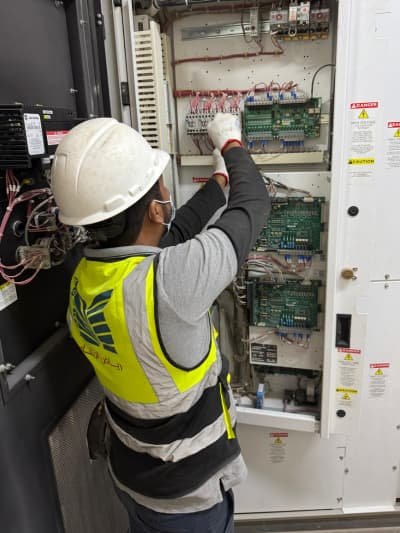
Need Help Solving VFD Undervoltage Issues?
Even the most reliable frequency converters can experience downtime. Understanding common DC undervoltage faults and their solutions helps you minimize downtime and maximize production efficiency.
At Riyadh Al Etqan (R-aletqan), we aim to be your go-to guide when challenges arise. Our team can provide expert support to quickly resolve VFD under voltage issues.
Contact us today to get the assistance you need and ensure your electrical systems operate reliably.
Conclusion
In summary, the higher DC bus voltage in VFDs is a deliberate design choice that enhances system performance, control, and efficiency. It also helps prevent issues like DC undervoltage in VFD systems, compensating for real-world challenges such as fluctuations or drops in the power supply voltage, and ensuring reliable operation of your equipment.
FAQs
What is the main cause of VFD under voltage faults?
Usually, load-side disturbances or problems with the input power supply—from the utility or the power source—are the main cause of Under voltage faults in a variable frequency drive (VFD).
Can under voltage damage a motor?
An electric motor can indeed be harmed by low voltage.
What is the minimum voltage for a VFD?
The rated voltage class is two-thirds of it.
How to check VFD DC bus voltage?
It is necessary to have a multimeter that can measure DC voltage. After setting the multimeter to the proper DC voltage range, attach the test leads to the DC bus terminals of the VFD, which are usually marked “+” and “-.”
What happens when a VFD experiences under voltage?
This may result in repeated resets, decreased motor performance, and, in extreme situations, shutdowns.