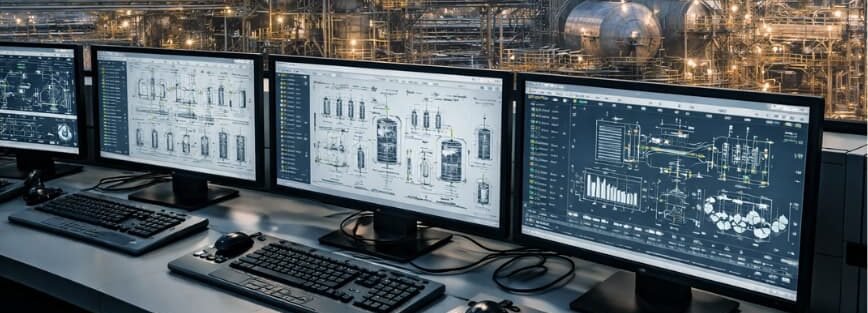
Dcs system provider in Jeddah R-aletqan provides a dependable DCS solution that boosts efficiency and streamlines intricate processes. Industrial machinery used in batch and continuous processes can be automated by a computerized system known as a Distributed Control System, or DCS, which reduces human and environmental risk.
Dcs system
The automated control system known as a Distributed Control System (DCS) is widely utilized in the operations of industrial plants. It is frequently referred to as a DCS in the instrumentation sector.
By designating controllers to specific pieces of equipment, a DCS decentralizes control in contrast to centralized systems. In addition to lowering labor costs and increasing operational efficiency, this strategy improves system dependability and permits the long-term, effective operation of large-scale facilities.
What is a distributed control system’s mechanism?
DCSs are made up of control devices scattered around a production or facility. Computers, sensors, and controllers are some examples of these control components. Each part has a specific purpose, such as collecting data, storing data, or controlling processes.
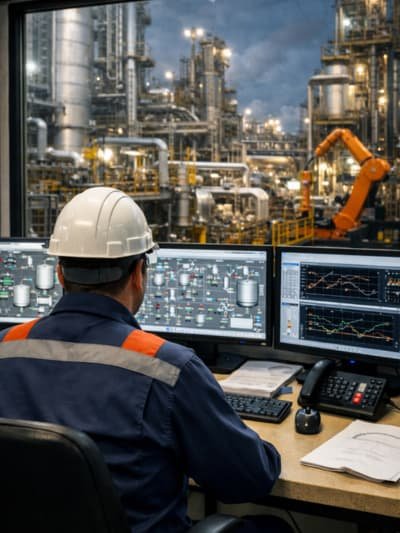
Each machine component can have its specialized controller that manages the operation, thanks to a DCS, as opposed to a centralized control system that manages all machines. In the plant, a DCS has many local controllers. Fast communication is used to link the local controllers. An operator is in charge of central supervisory control, even if each controller functions independently.
To provide a control, efficiency, and process quality approach, the control system architecture is dispersed across the factory or plant. And a plant can still function even if a component of the DCS design fails. For this reason, DSCs are commonly found in industrial and manufacturing environments. According to Markets and Markets Research, the market for DSCs is predicted to continue expanding, rising from $17.5 billion in 2021 to $23.2 billion by 2026.
A DCS system functions similarly to industrial control solutions that use supervisory control and data acquisition (SCADA). Transportation, water and waste management, telecommunications, oil and gas refineries, and power plants all employ SCADA systems. They are typically employed when the control center is located farther away.
Why Make Use of a DCS?
The main justifications for employing a DCS system provider in Jeddah are increased scalability, flexibility, and dependability. Real-time monitoring, which DCS systems provide, is crucial for maintaining process efficacy and safety.The system improves operational dependability by reducing the possibility of a single point of failure by dividing control across several nodes.
The features of R-aletqan improve DCS systems by facilitating real-time data streaming and smooth integration. This enhances operational efficiency and decision-making by enabling real-time ingestion, processing, and analysis of data from several DCS nodes.
Which distribution control systems are there?
Different types of DCS systems (DCSs) are made for particular industries and uses. Here are a few instances of typical DCS types:
● Systems for data acquisition and supervisory control (SCADA):
Many sectors heavily rely on SCADA systems, including transportation, oil and gas, water treatment, and power generation. They usually cover wide geographic regions and remotely monitor and operate machinery and operations. SCADA systems frequently entail data collection for analysis and decision-making from a central control center that communicates with distant field equipment.
● Systems with programmable logic controllers (PLCs):
PLCs are widely used in manufacturing and automation in industry. PLC systems are made up of many dispersed controllers that are linked to sensors, actuators, and other plant floor equipment. To manage and coordinate a variety of operations, including assembly lines, robotic systems, and material handling systems, they carry out preprogrammed logic.
● DCNs, or distributed control networks:
Chemical plants, refineries, and pharmaceutical manufacturing facilities are examples of process industries that employ DCN systems.They comprise many control units dispersed around the plant that work together to regulate and keep an eye on various process components.
Decentralized decision-making is made possible by DCN systems, which also offer redundancy for increased dependability.
● Industrial internet of things (IIoT):
IIoT systems collect and analyze data in real time from scattered sensors and devices using an internet connection and advanced analytics. They provide remote monitoring, predictive maintenance, and process optimization in several industries, including manufacturing, energy, and transportation.
For data processing and decision-making, IIoT systems frequently integrate edge computing capabilities with cloud-based platforms.
Important attributes and advantages
Compared to centralized control systems, distribution control systems (DCSs) provide several benefits. A distribution control system has several key benefits, including the following:
● Controllers versus Operator Interface:
In contrast to the operator interface, which is used for operation and monitoring, the controllers perform control calculations. In the case of an operator interface failure, this means that the controllers will continue to manage the process on their own, ensuring uninterrupted operation.
● Decentralized Setup:
System components can be installed in various locations across the facility. Field wiring expenses can be greatly decreased by placing input/output (I/O) nodes near the equipment using network connections, such as optical fiber.
● Improved Maintainability and Reliability
Isolation of Faults:
The functioning of other controllers is unaffected if one fails. The possibility of many systems going unmonitored at once is reduced by designating controllers to distinct pieces of equipment.
Planned Maintenance:
To enable continuous plant operation, maintenance can be carried out on a single piece of equipment at a time without affecting the system as a whole.
Adaptability and compatibility:
The DCS system provides a flexible way to integrate with various devices and systems. Their ability to connect with a wide range of protocols and interfaces makes it possible to integrate sensors, actuators, human-machine interfaces (HMIs), and other parts with ease.
Additionally, DCSs facilitate interoperability with corporate applications, data analytics platforms, and other control systems, allowing for improved integration throughout the automation ecosystem.
Advantages
- Future-proof technology protects your investments.
- Utilizing cutting-edge DCS system technologies to optimize for intelligent design and adaptable engineering
- Operational profitability may be measured at all industrial enterprise levels.
Conclusion
The highly accessible, fault-tolerant R-aletqan DCS family of components gathers, processes, and distributes important data across the plant. DCS system optimizes cost, space, and functionality needs by providing a variety of controller types and I/O choices with flexibility and scalability in mind.