
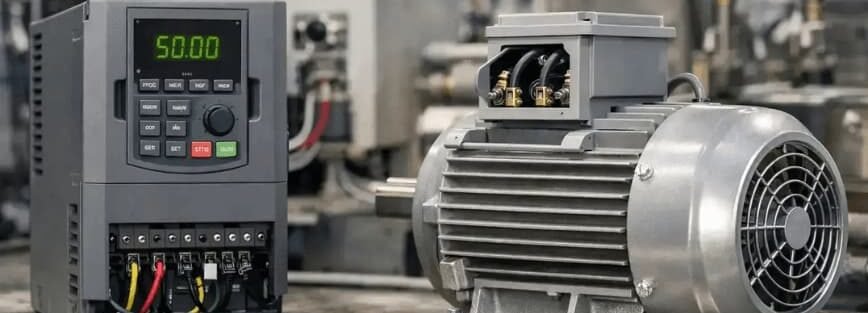
How to select a VFD for a motor is an important question for many engineers and plant operators. An alternating current (AC) induction motor’s speed can be controlled with a Variable Frequency Drive (VFD). VFDs are widely used when a motor does not always need to run at full speed, helping conserve energy and improve overall efficiency.
With several VFD options available on the market, choosing the right one can be challenging. To make the process easier, here are the five most important factors to consider when selecting a VFD, along with common mistakes to avoid, so you can ensure the best performance and reliability for your motor.
What Is a Variable Frequency Drive (VFD) and Why Does It Matter?
A Variable Frequency Drive (VFD) controls an electric motor by adjusting its frequency and voltage. Before exploring how to select a VFD, and more specifically how to select a VFD for a motor, it is important to know that a VFD is also called an adjustable frequency drive, variable speed drive, AC drive, micro drive, or inverter.
The frequency (hertz) of a motor is directly related to its RPM. As frequency increases, the RPM also increases. When full motor speed is not required, the VFD adjusts frequency and voltage to match the load demand. This flexibility allows the motor speed to change easily whenever the application requirements vary, improving efficiency and reducing energy consumption.

How to Select a VFD for a Motor: 5 Key Factors to Consider
Selecting the right VFD or motor controller can be challenging, as it depends heavily on your application and system requirements. There is no one-size-fits-all model or brand. A well-chosen VFD will be reliable, easy to use, and help save on energy, maintenance, and repair costs. Understanding your motor’s specific needs makes it much easier to choose the most suitable drive.
1. Determine the Correct Size VFD
The first step in how to select a VFD for a motor is ensuring the drive’s current rating matches your motor’s full load amps (FLA), not just its horsepower. Relying solely on horsepower can be misleading, as motors with the same horsepower may draw different currents depending on their speed (RPM) and load. Always check the motor’s nameplate for key details such as voltage, FLA, and RPM. Choosing a VFD with a slightly higher amp rating than required helps prevent device damage and nuisance tripping, ensuring safe and reliable operation.
2. Consider the Type of Load
After understanding how to select a VFD for a motor, it’s essential to consider what type of load the VFD will control, as the choice of drive depends on the load behavior. The VFD must provide enough current to ensure the motor delivers the required torque. Loads are generally categorized into five types: constant torque, variable torque, impact, constant horsepower, and breakaway loads. The torque requirement depends on speed, load size, and acceleration. Some VFDs are versatile enough to handle multiple load types effectively.
3. Voltage and Phase Considerations
Voltage and phase are critical when selecting a VFD. The VFD’s input voltage must match the power source, and the output voltage should align with the motor’s nameplate rating. The drive must also handle the motor’s phase arrangement, whether single-phase or three-phase. Ensuring the correct voltage and phase helps maintain torque output and prevents potential motor or VFD damage.
Voltage: The incoming power source voltage must be compatible with the VFD (e.g., a 480V source requires a 480V-rated VFD). The VFD adjusts the output voltage and frequency to maintain a constant V/Hz ratio, keeping torque roughly constant even at reduced speeds.
Phase: Verify that the input phase matches the VFD’s design. Most VFDs convert single-phase input to three-phase output if needed. Built-in phase protection prevents damage from phase loss or incorrect sequencing.
Additional Considerations:
1- Motor Compatibility: Ensure the motor is suitable for VFD operation, especially its winding design.
2- Enclosure: Choose an enclosure rated for the environment.
3- Ambient Conditions: Temperature, humidity, and altitude can affect performance.
4- Overload Capacity: The VFD should handle the motor’s starting current and load spikes.
5- Power Quality: Consider voltage imbalance and harmonics, especially in industrial applications.
4. Environmental Conditions
When choosing a VFD, it’s important to consider the environmental conditions where it will operate. Factors like temperature, dust, moisture, vibration, chemicals, and altitude can all affect VFD performance and longevity.
Temperature: VFDs have a specified operating range. Exceeding it can lead to derating or failure. Every 10°C above the recommended temperature can reduce VFD life by half.
Humidity: High humidity may cause condensation, leading to shorts or insulation damage. In such cases, desiccants or heaters might be needed.
Dust and Contaminants: Dust or corrosive chemicals can harm components. Enclosures with appropriate IP ratings are essential in harsh environments.
Altitude: High elevation can reduce VFD output power; adjustments may be necessary.
Vibrations and Shock: If the VFD will face vibration or mechanical stress, choose units with suitable mounting or vibration-damping features.
EMI/RFI: Electromagnetic or radio frequency interference can affect VFD operation and nearby sensitive equipment. Adequate shielding or filtering is recommended.
By carefully evaluating these environmental parameters, you ensure the selected VFD performs reliably and is well-protected in its operating conditions.
5.Control Features and Interfaces
Modern VFDs and variable speed drives (VSDs) provide a wide range of control options, from simple keypad controls to advanced programmable logic controller (PLC) interfaces using protocols such as MODBUS or PROFIBUS. Analog inputs (4-20mA, 0-10V), digital displays, and network connectivity modules may also be required depending on the application.
Choosing a VFD without the necessary control functions can limit your system’s performance or complicate future upgrades. Therefore, it is important to plan ahead and ensure that the selected drive supports both current and future automation requirements.
Read About: VFD motor overload fault
Common Mistakes to Avoid When Selecting a VFD
How to select a VFD for a motor by knowing the common mistakes and ways to avoid them:
1- Incorrect Sizing:
Mistakes include oversizing, which can lead to inefficiencies and excessive expenses, and undersizing, which can result in overload and overheating.
Avoidance: Choose a VFD that can control the load, including the initial current requirements, after determining the motor’s full load amperage (FLA).
2-Environmental Factors:
Mistake: Ignoring temperature, humidity, dust, and other environmental factors, which might cause early failure.
Avoidance: Make sure the VFD is rated for the working environment, or consider installing extra enclosures or cooling systems.
3- Starting current:
Mistake: Not accounting for the greater beginning current required by some applications, such as pumps and compressors.
Avoidance: Use a VFD with enough capacity to manage the initial surge without tripping.
4- Mismatch Between Motor and VFD:
Mistake: Using a VFD with an improper voltage, current, or power rating for the motor.
Avoidance: Make sure the VFD is compliant with the motor’s specs.
5-Harmonics:
Mistake: Ignoring the influence of harmonics (distortions in the electrical waveform), which can lead to power quality concerns and device failure.
Avoidance: Use harmonic filters or VFDs with built-in mitigation capabilities.
6-Improper Wiring:
Mistakes include improper grounding, loose connections, or employing the incorrect type of wire. Why is it a problem: Faulty wiring can lead to malfunctions, damage, and even safety issues.
Solution: Pay strict attention to the manufacturer’s wiring schematics and instructions, particularly the grounding requirements.
Read about: What causes a VFD to trip?
Need Help Choosing the Right VFD?
A good VFD should be easy to operate, reliable, and help you save costs on maintenance, utility bills, and equipment replacements. The more you understand your application needs, the easier it becomes to select the right VFD for a motor.
Riyadh Al Etqan Co. Danfoss Dealer in Riyadh, is your trusted partner to supply high-quality drives, provide expert repair services, and support complex automation challenges. With our global expertise and local support, we help you choose the right VFD quickly and effectively. Contact us today to speak with a specialist and get a quotation within one day.
Conclusion
There’s no one-size-fits-all solution when it comes to how to select a VFD for a motor. The right choice depends on factors such as motor size, load type, voltage, environmental conditions, and required control features. By carefully considering these criteria, you can ensure reliable performance, energy efficiency, and long-term cost savings.
FAQ
Can 1 VFD run 2 motors?
Yes, a single variable frequency drive (VFD) may operate many motors.
Can a VFD damage a motor?
A Variable Frequency Drive (VFD) can harm a motor if not utilized properly.
How to increase motor speed with VFD?
You need to raise the VFD’s output frequency.
Can you use a bigger VFD than the motor?
Yes, it is normally okay, and often even better, to utilize a VFD (Variable Frequency Drive) rated for more horsepower (HP) than the motor being controlled.