
Ever faced unexpected downtime due to faulty instrument loops in your plant? The Instrument Loop Check Procedure is a critical pre-commissioning step performed after installing field instruments. It ensures that every device communicates accurately with the control system whether a PLC or DCS providing reliable data and preventing costly errors during plant startup.
Instrument Loop Check Procedure in Heavy Industry Plants
In heavy industry plants, the Instrument Loop Check Procedure ensures that wiring, signal transmission, and industrial instrument functionality are correctly implemented before startup. This process helps engineers detect issues early, reduce commissioning delays, and support safe, reliable plant startup.
What Does the Instrument Loop Check Procedure Verify?
The procedure confirms:
- Correct installation and wiring of field instruments
- Availability of loop power
- Proper functioning of PCS input and output cards
- Accurate signal transmission between field instruments and PLC or DCS systems
Key Elements of the Procedure
- Inspection of Components: Verify that sensors, transmitters, controllers, and actuators are installed and wired correctly.
- Calibration and Adjustment: Ensure transmitters and sensors are calibrated for precise readings.
- Verification of Signals: Confirm that the controller receives the correct signals from the transmitter.
- Testing Responses: Verify actuator reactions to controller commands.
- Troubleshooting: Resolve issues such as delays, misconfigurations, or signal loss.
Loop Checking Phases
- Cold Loop Check: Performed with the system de-energized, focusing on wiring, connections, and correct installation of components.
- Hot Loop Check: Performed with the system powered on, verifying signal integrity, signal simulation, calibration, and control operation.
Benefits of Instrument Loop Check
- Reliable and accurate data for efficient process control
- Enhanced process efficiency by detecting and resolving issues early
- Increased safety by preventing process disruptions
- Reduced downtime during plant startup and operation
Sample Methods of Instrument Loop Check Procedure:
- Level Transmitter Loop: Verify the transmitter range using known liquid levels (e.g., 0% level in an empty tank).
- Gas Detector, Horn, and Beacon: Test the DCS setup by adding calibration gases and checking system response at different concentrations.
Flow Loop: Adjust output signals manually to verify control valve movement, transmitter installation, cable termination, and DCS settings.
Read About: Flow Meter Calibration Frequency: How Often Is Right?
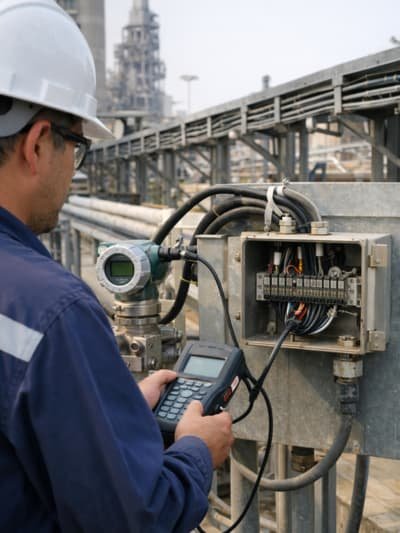
How Do I Verify a Loop from Field Instrument to DCS?
Verifying a loop from a field instrument to a Distributed Control System (DCS) is a critical step to ensure precise and reliable signal transmission. This procedure confirms that all wiring, components, and signals function correctly before plant operation.
Getting Ready and Reviewing the Documentation: Compile all relevant documents, such as DCS setup information, instrument calibration sheets, and loop drawings, and verify that the field instrument and its associated I/O channel in the DCS are correctly tagged and identified.
Verification of Field Instruments: Inspect the instrument visually to ensure proper labeling, secure connections, and correct installation. Make sure the device is powered on and, if it has a local display, verify that the reading matches expected values.
Function Testing (if applicable): Put the loop in manual mode in the DCS if it includes a final control element, such as a control valve. Send control instructions (0%, 25%, 50%, 75%, 100% output) from the DCS and observe the physical response of the final control element to confirm movement and feedback.
Documentation and Sign-off: Record all test results on a loop check sheet, including observed DCS readings, simulated values, and any inconsistencies or corrective actions implemented. Obtain the required approvals from client representatives, QA/QC, and instrumentation engineers.
Read About: Pre commissioning checklist for instrumentation
Cold vs Hot Loop Check: What’s the Difference in Industrial Commissioning?
There are two different stages of testing in automation and control systems: cold loop checks and hot loop checks
- Cold loop checks ensure that connections are intact by confirming the system’s continuity and physical wiring while it is not powered on.
- Hot loop checks are carried out while power is supplied to confirm the system’s operation and input response.
Check the Cold Loop:
- Goal: Confirm the loop’s continuity and physical wiring, making sure every part is connected correctly before power is provided.
- Approach: Carried out without electricity, checking the circuit for resistance and continuity using instruments like an ohmmeter.
- Attention: Inspect cables for correct termination, damaged wires, shorts, and physical connections.
- Time: Usually the first commissioning process, carried out before the system receives any electricity.
Check the Hot Loop:
- Goal: Confirm the loop’s operation, including the correct operation of field instruments and the control system’s reaction to inputs.
- Approach: Carried out by applying electricity, simulating process inputs, and monitoring the system’s response.
- Attention: Verify the system’s overall reaction to stimuli, calibration, alarm activation, and proper signal transmission.
- Time: Usually comes after a successful cold loop check, frequently carried out before system restart.

Common Problems Engineers Face During Loop Check in Cement and Power Plants
During loop checks in cement and power plants, engineers often face challenges that can affect accuracy and reliability. Identifying these issues early ensures smooth commissioning and operation.
- Incorrect Wiring or Connections:
Loose or misconnected cables can cause signal loss, false readings, or alarms. - Power Supply Issues:
Unstable or insufficient power can lead to inconsistent transmitter readings or control failures. - Calibration Errors:
Improperly calibrated sensors or transmitters give inaccurate measurements, impacting process control. - Signal Transmission Problems:
Signal loss, interference, or incorrect signal simulation can cause discrepancies between field instruments and control systems. - Faulty Field Instruments:
Damaged sensors or actuators may fail under harsh plant conditions like high temperatures, dust, or vibration. - Control System Configuration Errors:
Wrong DCS or PLC configuration, including I/O mapping or scaling errors, can lead to misinterpreted signals. - Environmental and Mechanical Factors:
Vibration, dust, moisture, and temperature fluctuations can affect loop integrity and instrument performance.
Addressing these issues during loop checks ensures reliable data, accurate control, and reduces downtime during commissioning.
What Should Be Included in a Loop Check Sheet for QA/QC?
- Field instrument ID and location
- Wiring and connection verification
- Power availability
- Signal readings and simulated values
- Calibration status
- Any discrepancies or corrective actions
- Sign-offs from QA/QC, instrumentation engineer, and client representative.
Recommended Tools and Simulators Used in Instrument Loop Checks
-
- Multimeter and ohmmeter for continuity checks
- Loop calibrators for signal simulation (4–20 mA, HART)
- Pressure and temperature simulators for transmitters
- Function generators for control valves and actuators
- Safety equipment for field operations
How Are Loop Checks Performed? Step-by-Step Breakdown for Field Engineers
- Review documentation and loop diagrams
- Inspect field instruments and wiring
- Perform cold loop check (system de-energized)
- Perform hot loop check (system powered, signal simulation)
- Verify actuator responses and DCS/PLC readings
- Record results and obtain sign-offs
Need Expert Support with Instrument Loop Checks?
RETQAN offers professional instrument loop check services for heavy industry plants, including cement, power, and manufacturing facilities. Our experienced engineers ensure accurate signal transmission, proper calibration, and reliable communication between field instruments and your PLC or DCS systems. We help minimize downtime, troubleshoot complex loops, and provide full QA/QC documentation, ensuring safe and efficient plant commissioning.
FAQ
Can I perform a loop check without energizing the system?
It is possible to do a cold loop check without reviving the system.
Is there a difference in loop check procedures for PLCs vs. DCS systems?
Indeed, PLC and DCS systems differ in their loop check protocols.
How can I identify a wiring mismatch during a loop check?
Check continuity with a multimeter or ohmmeter and verify correct connections against the loop diagram.
Do I need to repeat loop checks after minor cable repairs?
Yes, even minor repairs require rechecking the loop to ensure proper signal transmission and system integrity.