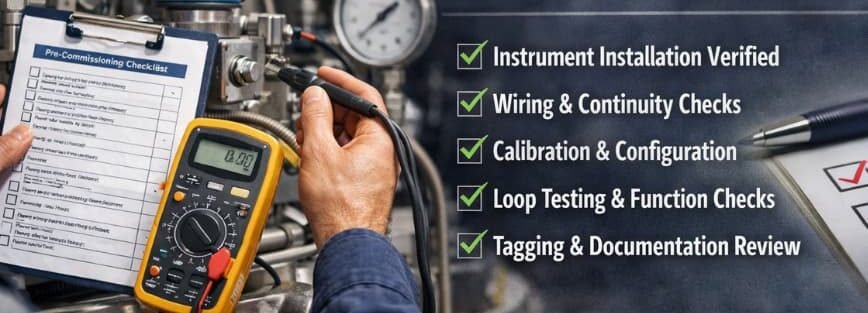
A single unverified instrument can delay startup or cause commissioning tests to fail.
A pre commissioning checklist for instrumentation ensures that all installed instruments are properly mounted, calibrated, and connected, and ready to perform reliably during system-wide testing. This structured approach helps minimize late-stage rework, unexpected issues, and startup delays.

Pre Commissioning Checklist for Instrumentation in Heavy Industry
In heavy industry, a pre-commissioning checklist for instrumentation guarantees that every instrument is properly mounted, calibrated, and operational. It encompasses things like reviewing paperwork, verifying mechanical completeness, checking electrical systems, and checking certain instruments. The smooth transition between the starting and commissioning phases is ensured by this comprehensive approach.
The checklist covers the following aspects to ensure all instruments are properly installed, calibrated, and ready for commissioning:
Review of Documentation
- Examining the design documents: Check that all P&IDs, vendor documentation, and loop diagrams are present and compliant with the project requirements.
Mechanical Finalization
- Confirm that all pipes, equipment, valves, and nozzles are placed accurately and in line with the requirements.
- NDT and welding: Confirm that the weld joints have been inspected and meet all specifications.
- Hydrotesting: Verify that pipeline and vessel pressure tests have been finished and recorded
Electrical Inspections
-
-
- Continuity: Check each circuit’s electrical continuity.
- Insulation Resistance: Verify that insulation resistance satisfies the requirements.
- Earthing: Make sure that every piece of equipment is properly grounded.
- Test circuit breakers to make sure they are operating properly.
- Verify the phase sequence of electrical systems to make sure it is proper.
- Safety Features: Verify that interlocks and emergency stops are operating as intended.
- Hazardous Region Inspections: Visually examine electrical equipment in hazardous places to make sure it is placed correctly and suitable for the region.
Instrumentation Inspections
-
- Adjustment: Confirm that all instruments have valid calibration certificates and are calibrated according to specifications.
- Testing Loops: Test loops to ensure that instrument loops are functioning and communicating properly.
- Direction of Flow: Verify that check valves, orifice plates, and control valves are placed in the proper orientation by P&IDs.
- Ensure instruments are appropriately orientated and mounted.
- Tests for Leakage: Conduct leakage testing to find and fix any possible leaks in the instrument connections.
- Flushing: Make sure the instrument lines are flushed properly to remove impurities or dirt.
- System of Control: Confirm that the DCS and PLC control systems are set up correctly and prepared for use.
- Safety Systems: Verify that alarms, fire and gas systems, ESD, and other safety systems are operating properly.
- Documentation: Verify that all pertinent documentation is current and available, including datasheets, loop diagrams, and calibration records.
- Instrument Nozzles: Verify that the instrument nozzles are in the proper location and are not blocked.
- Internals and Trays: Verify the correct fit, levelness, and orientation of internal parts such as trays and baffles.

Essential Tools for Instrumentation Pre-Commissioning in Cement and Steel Plants
Instrumentation pre-commissioning in cement and steel plants requires specific tool categories to ensure accurate testing, safe execution, and proper system readiness before commissioning.
1. Calibration Tools
-
- Pressure, temperature, and multifunction calibrators for verifying and adjusting transmitters, switches, gauges, and flow meters according to design requirements.
2. Loop Testing Tools
- Signal generators, multimeters, and HART communicators used to simulate process signals, verify loop integrity, and confirm reliable communication with PLC/DCS systems.
3. Diagnostic Tools
-
-
- Vibration analyzers, infrared thermometers, and gas detectors for early detection of mechanical, electrical, and safety-related issues during pre-commissioning.
-
4. Safety and Control Requirements
- Lockout/tagout equipment and personal protective gear to ensure safe execution of pre-commissioning activities.
- Controlled documentation such as P&IDs, loop check records, and calibration certificates to maintain traceability and compliance.
Read about: Flow Meter Calibration Frequency: How Often Is Right?
QA/QC Standards and Documentation Used During Pre-Commissioning
During the pre-commissioning phase, a pre commissioning checklist serves as a structured guide to verify that every instrument and system component meets project specifications. It helps engineers and technicians systematically inspect installations, confirm calibrations, and ensure that all safety and control systems are functioning correctly before the facility moves into full-scale commissioning.
Key aspects include:
-
- Compliance Verification: Ensuring all instruments, equipment, and installations meet the applicable industry standards, codes, and client specifications.
- Inspection Records: Maintaining detailed logs of all inspections, tests, and calibration activities to provide traceability and accountability.
- Non-Conformance Management: Documenting any deviations or defects found during pre-commissioning and tracking corrective actions until resolution.
- Approval Workflows: Using formal sign-offs from engineers, QA inspectors, and project managers to validate that each activity has been completed satisfactorily.
- Documentation Control: Storing datasheets, calibration certificates, test reports, and checklists in an organized manner, allowing easy retrieval for audits or commissioning handover.
By strictly following QA/QC procedures, facilities can minimize operational risks, ensure regulatory compliance, and achieve a smooth transition to commissioning.
How to Integrate Pre-Commissioning with Preventive Maintenance Plans
Integrating pre-commissioning activities with preventive maintenance plans ensures that all insights gained during startup are used to optimize long-term equipment reliability. Key steps include:
- Record Findings: Document calibration results, installation issues, and system performance observed during pre-commissioning.
- Update Maintenance Schedules: Use this data to refine preventive maintenance intervals and inspection routines.
- Create Actionable Checklists: Convert observed anomalies or trends into preventive tasks for the maintenance team.
- Continuous Monitoring: Incorporate instrumentation data and test results into ongoing maintenance monitoring systems.
- Feedback Loop: Regularly review the effectiveness of maintenance plans and adjust based on operational performance and lessons from commissioning.
Common Instrumentation Issues Found During Pre-Commissioning and How to Solve Them
- Incorrect Calibration: Verify calibration certificates and recalibrate instruments if needed.
- Improper Installation or Orientation: Check mounting and alignment according to P&IDs.
- Leaks in Connections: Conduct leakage tests and tighten or replace faulty fittings.
- Signal/Communication Failures: Test loops and troubleshoot wiring or protocol issues.
- Misaligned Valves or Sensors: Inspect and adjust orientation to ensure accurate operation.
Ensuring Safety and System Compatibility with PLC/DCS During Pre-Commissioning
- Verify Control Logic: Check that PLC/DCS programs operate as intended and interlocks respond correctly.
- Signal Integrity: Confirm all input/output signals from instruments reach the control system accurately.
- Safety Systems Check: Test emergency stops, alarms, fire & gas detection, and ESD systems.
- System Integration: Ensure PLC/DCS communicates correctly with all subsystems and field devices.
- Documentation & Records: Maintain records of tests, anomalies, and approvals for traceability.
How RETQAN Ensures Reliable Instrumentation Pre-Commissioning
At RETQAN, our team performs precise installation checks, calibration, and loop testing for motors, drives, and control instruments. Using advanced tools and strict QA/QC procedures, we ensure all systems are ready for commissioning, minimizing downtime and guaranteeing reliable plant operation.
FAQs
Can we skip pre-commissioning if individual instrument tests are completed?
No, even if individual instrument testing is finished, it is usually not advised to forgo pre-commissioning.
Do I need to repeat pre-commissioning after rework or project delays?
Yes, pre-commissioning operations must usually be repeated due to rework and project delays.
What happens if pre-commissioning reveals missing tag numbers or incorrect installation?
Pre-commissioning initiates a process of repair and re-verification if it finds faulty installation or missing tag numbers.
Is it necessary to document every pre-commissioning activity formally?
Yes, it is typically necessary to properly document pre-commissioning processes.