Types of power quality disturbances can have very real consequences: a momentary voltage dip can trip a drive, reset a PLC, or stop a production line, often with no obvious cause. Voltage sags, voltage swells, interruptions, harmonic distortion, and transient events can affect the performance, reliability, and lifespan of industrial equipment. Understanding these disturbances and their classification helps electrical engineers identify risks, troubleshoot recurring failures, and select suitable improvement measures.
For Saudi industrial facilities operating motors, automation systems, drives, and control panels, power quality analysis helps turn unexplained trips into identifiable and actionable problems while supporting sound LV and MV electrical system planning.
What Are Power Quality Disturbances?
Power quality disturbances are unwanted changes in voltage, current, or frequency that cause electrical power to deviate from normal operating conditions. The main types of power quality disturbances include voltage sags, voltage swells, interruptions, harmonic distortion, transient disturbances, voltage imbalance, and voltage fluctuations.
These events can affect industrial equipment performance, create nuisance trips, increase maintenance requirements, and reduce electrical system reliability. Power quality monitoring and engineering assessment help facilities identify disturbance sources and improve electrical performance.
Modern industrial facilities face increasing power quality challenges because many processes depend on electronic equipment such as:
- Programmable logic controllers (PLCs).
- Variable frequency drives (VFDs).
- Industrial automation systems.
- Digital protection relays.
- Process instrumentation.
- Computerized control systems.
Unlike traditional electrical loads, electronic equipment can be highly sensitive to short-duration disturbances that may not be noticeable through conventional electrical inspections.
For industrial facilities in Saudi Arabia, power quality assessment is particularly relevant because large motors, pumping systems, HVAC equipment, production machinery, and automation platforms often operate continuously under demanding conditions.
Types of Power Quality Disturbances Engineers Encounter
The classification of power quality disturbances helps engineers understand the relationship between electrical symptoms, possible causes, and appropriate corrective actions. Each disturbance type requires different investigation methods because the cause may exist in the utility supply, internal electrical distribution, connected equipment, or system design.
| Disturbance | What It Is | Common Causes | Industrial Impact |
|---|---|---|---|
| Voltage Sags | A temporary reduction in voltage magnitude below the normal operating level, lasting from a few milliseconds to several seconds. | Short circuits in electrical networks, utility feeder faults, starting large induction motors, heavy load switching, weak distribution systems, long cable runs with significant voltage drop. | Affects motor starters, VFDs, PLC systems, communication networks, control circuits, and process automation equipment. Symptoms: unexpected equipment trips, production line stoppage, control system resets, loss of communication. |
| Voltage Swells | A temporary increase in voltage above the normal operating level. | Sudden disconnection of large loads, incorrect voltage regulation, switching operations, network disturbances, unbalanced electrical conditions. | Repeated events may cause malfunction or reduced operating life of electronic power supplies, control equipment, protection devices, motors, and insulation systems. |
| Electrical Interruptions | Voltage is reduced significantly or completely lost for a specific period. | Temporary interruptions: protective device operation, automatic restoration systems, short circuit clearing. | Sustained interruptions: production downtime, equipment restart procedures, process instability, additional maintenance activities. |
| Harmonic Distortion | Non-linear loads draw current that does not follow the normal sinusoidal waveform. | VFDs, UPS systems, power converters, electronic power supplies, industrial automation equipment. | Transformer overheating, increased electrical losses, motor heating, incorrect measurement readings, reduced equipment efficiency, premature component ageing. |
| Transient Disturbances | Rapid electrical changes occurring over very short time periods. | Lightning strikes, circuit breaker switching, capacitor bank operation, electrical fault clearing. | Can damage or disturb control boards, instrumentation equipment, communication systems, and protection devices. |
Voltage sags: Large motors are one of the most common sources of voltage dips because starting current can be several times higher than normal operating current. A short voltage dip may cause a drive or controller to shut down even when the supply returns to normal immediately afterward. When repeated voltage sag events occur, engineers should investigate electrical loading conditions, motor starting methods, and distribution system performance.
Voltage swells: Although voltage swells are generally shorter than permanent overvoltage conditions, repeated events may stress electrical equipment over time.
Electrical interruptions: Interruptions are classified according to their duration and operational impact. These events may disappear quickly but can still affect industrial processes. Industrial facilities with continuous processes usually evaluate interruption risks during electrical reliability studies and expansion projects.
Harmonic distortion: Harmonic distortion is one of the most common electrical power quality issues in modern industrial systems. Industrial facilities should consider harmonic analysis when installing or expanding systems containing significant power electronic loads.
Transient disturbances: Because these disturbances happen quickly, conventional monitoring methods may not always detect them without dedicated power quality monitoring equipment.
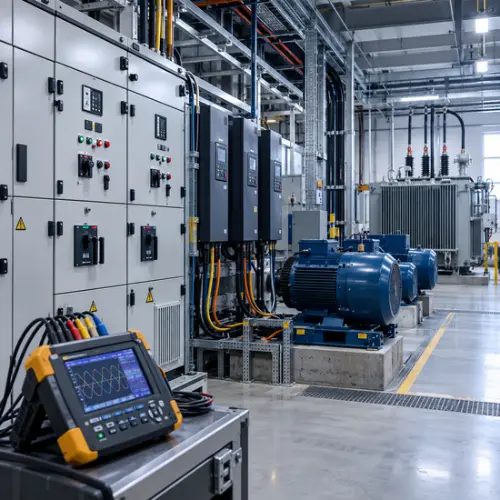
What Causes Power Quality Disturbances in Industrial Facilities?
Power quality problems usually result from a combination of electrical system conditions and operating practices.
- Non-linear loads: Equipment using electronic switching technology can introduce waveform distortion. Examples include VFDs, rectifiers, chargers, and automation systems.
- Motors and drives: Large motors can create voltage variations during starting and stopping operations. Drive settings, motor selection, and electrical supply conditions all influence system behavior.
- Switching operations: Electrical switching activities may create temporary disturbances. Examples include transformer energization, capacitor switching, and circuit breaker operation.
- Poor electrical design: Power quality problems may occur due to incorrect cable sizing, insufficient short-circuit considerations, poor grounding practices, and inadequate distribution planning.
- Equipment ageing: Older electrical equipment may experience insulation degradation, loose connections, reduced performance, and increased fault probability.
- Utility supply events: Disturbances may also originate in the utility network, such as feeder faults, utility switching operations, and lightning strikes.
How Power Quality Disturbances Affect Industrial Equipment
Power quality directly affects industrial reliability, operational continuity, and equipment performance. Depending on the types of power quality disturbances present, poor power quality may create:
- Equipment reliability issues: Electrical disturbances can increase stress on motors, drives, transformers, control equipment, and electronic components.
- Unexpected shutdowns: A short disturbance may trigger protective actions or equipment trips, resulting in unplanned downtime.
- Maintenance challenges: Without proper analysis, maintenance teams may replace components repeatedly without identifying the original electrical cause.
- Production continuity risks: Industrial processes depend on stable electrical performance. Power interruptions or equipment trips may affect production schedules and operational efficiency.
- Energy efficiency considerations: Poor power factor, harmonics, and electrical losses may increase energy consumption and reduce system efficiency.
Diagnosing Power Quality Disturbances
A structured engineering investigation is usually more effective than replacing equipment based only on symptoms. Engineers can identify power quality problems by:
• Reviewing when failures occur and which equipment is affected.
• Monitoring voltage variations, current distortion, frequency changes, and harmonic levels.
• Analyzing event records for timing, duration, severity, and possible sources.
• Inspecting connections, protection settings, and cable conditions.
• Reviewing maintenance history, since repeated failures often indicate an underlying electrical issue rather than isolated equipment defects.
• Conducting a professional electrical assessment to connect measured data with practical improvement options.
Saudi Grid Code and Power Quality Requirements
The Saudi Arabian Grid Code sets power quality limits for users connected to the transmission system, covering voltage harmonics, current harmonics, voltage unbalance, voltage fluctuation, flicker, and transient protection. For facilities connected at distribution level, applicable requirements should be confirmed against the relevant Saudi distribution requirements and site connection conditions. In practice, demonstrating compliance starts with measured data, which is why power quality monitoring is an important first step in many assessments.
How to Mitigate Power Quality Disturbances in Industrial Facilities
Effective mitigation depends on the type of disturbance and its source, which is why measurement should come before selecting a solution. Common engineering measures include:
- Voltage sags and swells: Use UPS systems or dynamic voltage restorers (DVRs) to protect sensitive loads, reduce motor starting impact with soft starters or VFDs, and review voltage regulation and protection coordination.
- Harmonic distortion: Install passive or active harmonic filters, line or DC reactors, or select low-harmonic drives for large power electronic loads.
- Power factor correction: Use detuned capacitor banks with reactors to avoid resonance with system harmonics.
- Voltage fluctuations and flicker: Apply dynamic compensation such as SVC or STATCOM for rapidly changing loads like arc furnaces and rolling mills.
- Transients: Install surge protective devices and maintain proper grounding and bonding.
- Voltage imbalance: Redistribute single-phase loads across phases and inspect connections.
Selecting a solution without measured data can make the problem worse. For example, adding a standard capacitor bank to a network with high harmonic content can create resonance and increase distortion instead of reducing it.
How RETQAN Diagnoses and Solves Power Quality Issues
RETQAN approaches power quality issues by first identifying the disturbance source and its impact on connected equipment, reviewing electrical system data, operating conditions, loading, and recurring disturbance patterns.
Based on the findings, RETQAN supports suitable solutions such as harmonic mitigation, power factor correction, voltage regulation, and electrical system upgrades, selected according to system characteristics and operational requirements. As a channel partner and system integrator for ABB and Siemens, RETQAN supports industrial electrical systems involving LV and MV drives, switchgear, and protection systems.
FAQ
What is the difference between voltage sag, swell, and a power interruption?
All three are changes in voltage magnitude, and the difference is direction and severity. A voltage sag is a temporary reduction in voltage, usually caused by faults or motor starting. A voltage swell is a temporary increase, often caused by sudden load disconnection or a single line-to-ground fault. A power interruption is a much deeper loss, where voltage drops close to zero or is lost completely. Sags and swells often pass unnoticed by people but can still trip drives and reset controllers, while interruptions typically stop equipment outright.
Can Variable Frequency Drives (VFDs) cause power quality problems?
Yes. VFDs are non-linear loads, so they draw current that does not follow a sinusoidal waveform and inject harmonics into the supply. In facilities with many drives, this can cause transformer and motor heating, additional losses, nuisance trips, and resonance problems when capacitor banks are present. At the same time, VFDs are also sensitive to voltage sags, and can trip on undervoltage even during short dips. The impact depends on the drive size relative to the supply, and it can be reduced with line or DC reactors, multi-pulse or active front end drives, and harmonic filters.
Do I need a power quality audit before installing new motors or VFDs?
Not always, but it is recommended in many cases. A small number of drives on a strong supply rarely needs one. A baseline assessment is worth doing when the new equipment is large compared to the existing system, when the facility already has unexplained trips or failures, when capacitor banks are installed, when the network is weak, or when the utility or connection agreement sets harmonic limits. Measuring before installation costs far less than diagnosing problems afterwards.