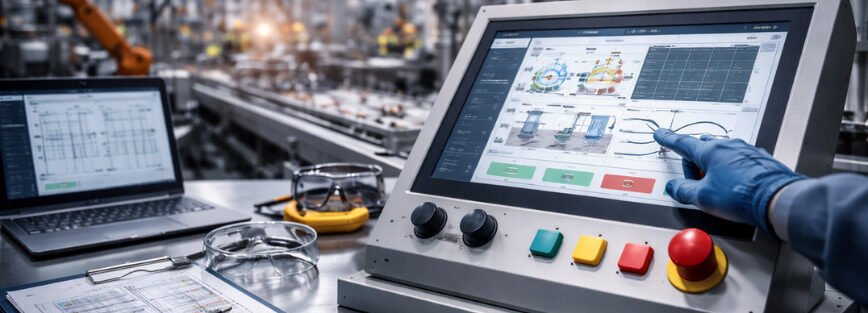
In today’s competitive manufacturing sector in Riyadh, efficiency and control are no longer optional; they are essential. HMI systems have become the core interface between operators and industrial machines, enabling real-time monitoring, accurate decision-making, and safe plant operations. As automation continues to expand, understanding the role of Human-Machine Interface solutions is key to achieving operational excellence.
How HMI Systems Control and Simplify Industrial Operations
Human-Machine Interface (HMI) systems are the central link between operators and industrial machinery. They provide intuitive, real-time visualization of machines and production processes, allowing operators to monitor performance, respond to alarms, and adjust operations immediately. By transforming complex industrial data into simple, actionable visuals, HMI systems ensure safe, reliable, and efficient production while giving operators full control over automated processes.
HMI Technology: Boosting Efficiency in Capital Industries
HMI systems play a crucial role in capital-intensive industries by enabling real-time monitoring, efficient control, and safe operations. They reduce human error, simplify data management, and provide operators with user-friendly interfaces to manage complex automated processes.
Significance of HMI Technology in Capital Industries:
- Increased Productivity and Efficiency:Automates repetitive tasks and allows operators to manage machines easily, simplifying complex industrial processes.
- Real-Time Monitoring and Control: Provides dashboard-style visibility of operations, allowing quick problem detection and reduced downtime.
- Enhanced Compliance and Safety:Supports safety procedures like emergency shutdowns and ensures adherence to industry standards with real-time alerts.
- Data Administration and Analysis: Collects, stores, and displays historical and real-time data to support continuous improvement and performance monitoring.
- Flexibility and Remote Access: Enables operators to monitor operations from any location, improving responsiveness.
- Simplified Operations for Complex Systems: Makes automated systems easier to handle, freeing operators to focus on higher-value work.
Design Principles for Manufacturing HMI
Effective HMI systems in manufacturing focus on clarity, consistency, and operator-friendly design. By prioritizing user-centric interfaces, these systems ensure safe, efficient, and smooth industrial operations. In industrial facilities across Riyadh, real-time visuals, structured data, consistent navigation, and well-tested interface elements help operators monitor and control processes with confidence.
Key Principles:
- Clarity and Simplicity:Present information clearly and remove unnecessary elements.
- Consistency:Maintain uniform layouts, colors, and navigation across all screens.
- Visibility:Make critical industrial data easy to access using appropriate fonts, symbols, and colors.
- Immediate Feedback:Provide visual, auditory, or tactile signals to confirm operator actions.
- Error Handling:Include validation, warnings, and undo options to prevent mistakes and simplify recovery.
- Accessibility:Ensure usability for operators of all skill levels.
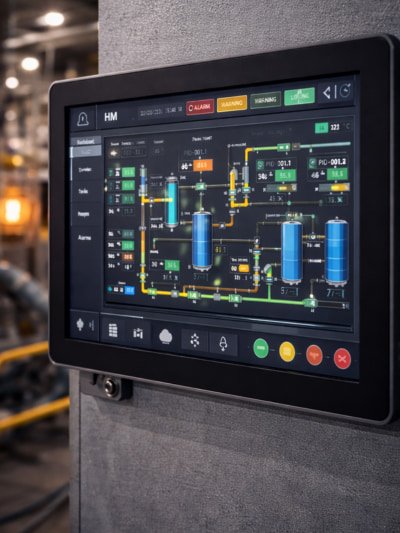
Best Practices for Industrial HMI
Successful industrial HMI systems are built with the operator in mind, ensuring safety, efficiency, and ease of use. In manufacturing facilities across Riyadh, following best practices helps operators control complex systems, monitor real-time data, and respond quickly to alarms and events.
Key Best Practices:
- User-Centered Design: Focus on operator needs, tasks, and edge cases to create durable and intuitive interfaces.
- Dynamic Visualization: Use real-time visuals to track trends and display system status clearly.
- Logical Information Architecture:Organize data according to workflows and operational priorities for faster comprehension.
- Display Hierarchy: Use multiple display levels, such as Overview, Unit Control, Detail, and Support screens.
- Safety and Compliance:Include clear alarms, error reporting, and emergency stop controls to meet regulatory requirements.
- Contextual Testing: Test interfaces in real-world scenarios to ensure operators can interpret data and complete tasks reliably.
- Clear Visual Language:Employ simple graphics, concise text, and thoughtful color usage to convey information effectively without clutter.
Integration with Local SCADA Systems
HMI systems work hand-in-hand with SCADA (Supervisory Control and Data Acquisition) to provide clear visualization and control of industrial processes. In manufacturing plants across Riyadh, this integration ensures operators can see real-time data, control machinery efficiently, and make informed decisions while SCADA manages plant-wide supervision and data analysis.
Key Elements of SCADA and HMI Integration:
- Component Roles:SCADA manages the overall system and data collection, while HMI provides an intuitive interface for local operations.
- Data Flow: Real-time data from sensors and devices is displayed on HMIs, enabling operators to make immediate adjustments.
- Communication Protocols: Ensure accurate and reliable data transfer between machines, sensors, and HMI screens.
- Usability: HMIs give detailed insights into process conditions like temperature or pressure and allow instant control actions.
- Enterprise vs Local Level:SCADA coordinates plant-wide operations, while HMIs focus on individual process areas with direct operator interaction.
- Control Logic: PLCs execute commands received from SCADA/HMI software to manage actuators and devices.
Advantages:Integration provides actionable insights, increases efficiency, reduces downtime, and supports data-driven decision-making.
Arabic Language Interface Development
Developing HMI systems in Arabic ensures that operators can efficiently monitor and control industrial processes using their native language. In manufacturing facilities across Riyadh, designing interfaces with right-to-left (RTL) orientation, clear Arabic labels, and intuitive layouts improves usability and reduces errors for Arabic-speaking operators.
Key Aspects of Arabic HMI Development:
- HMI Definition: A dashboard or display that provides operators with information to monitor and control machinery.
- Language Integration: Adapt interfaces for Arabic to ensure readability and clarity for operators.
- Technical Challenges: Ensure correct display of Arabic text, numbers, and images in right-to-left order.
- Interface Design:Create intuitive, user-friendly layouts that transcend language and cultural barriers.
- Development Tools:Use specialized software to design visual components and user interactions.
- Goal: Enable effective control and monitoring of industrial processes while providing Arabic-speaking operators the same functionality and usability as standard HMI systems.
Maintenance Support: Keeping Industrial Systems Reliable
Keeping industrial systems and HMI software running smoothly is essential. In Riyadh’s manufacturing plants, maintenance ensures reliability, minimizes downtime, and maximizes performance.
Key Services:
- Software & IT: Updates, monitoring, and troubleshooting.
- Facilities: HVAC, electrical, and plumbing upkeep.
- Industrial Equipment:Maintenance of machinery and plant systems.
- Air Traffic & Medical Systems:Specialized round-the-clock support.
Benefits:
- Reduces costs through preventive care.
- Enhances safety and compliance.
- Maintains system reliability and performance.
Why Choose Riyad Al-Etqan for Your HMI Solutions
At Riyad Al-Etqan we specialize in providing reliable and efficient HMI systems for manufacturing facilities in Riyadh. Our team of experts ensures seamless integration, real-time monitoring, and optimal performance of your industrial operations. With years of experience, we help factories minimize downtime, improve productivity, and maintain the highest safety standards.
Our Key Services:
- Expert installation and configuration of HMI systems
- Integration with SCADA and PLC systems
- Arabic interface development for user-friendly control
- Preventive maintenance and troubleshooting
Conclusion
HMI systems are no longer just tools—they are essential partners in industrial efficiency and safety. By applying clear design principles, integrating seamlessly with SCADA, and supporting local operations in Riyadh, factories can streamline processes, reduce errors, and empower operators to focus on high-value tasks.
Choosing the right HMI solutions ensures smarter decision-making, smoother workflows, and long-term operational success. With expert implementation and ongoing support, industrial facilities can stay ahead in a competitive and evolving landscape.