

SCADA security best practices are essential to protect industrial operations in Saudi Arabia from cyber threats that can disrupt monitoring, trigger false alarms, and delay engineering responses. SCADA platforms often connect PLCs, RTUs, networks, HMI clients, servers, historians, and remote access paths, meaning a single vulnerability can affect the entire operation, not just one screen.
This article explains SCADA security and SCADA protection from a practical, documented perspective, including standards, security management, audits, backup and disaster recovery, and safe IIoT integration.
SCADA Security Best Practices for Industrial Systems
SCADA security best practices are a set of technical and operational controls designed to protect industrial control systems from cyber threats, unauthorized access, and operational disruptions. Implementing these measures effectively comes from applying disciplined basics consistently over time. Their impact is strongest when documented, enforced, and regularly reviewed. Often, the most secure environments are not the most complex—they are the most disciplined.
Common practical best practices in industrial control include:
- Maintain asset inventory – ensures full visibility and quick detection of vulnerabilities.
- Segment networks – prevents unauthorized access between IT and OT environments.
- Restrict remote access – with logging to reduce exposure from external connections.
- Controlled backups – ensures fast recovery in case of incidents.
- Review user accounts – remove unnecessary or shared access to maintain accountability.
- Approved change management – avoids undocumented changes and potential risks.
- Monitor critical logs – detects abnormal activities early.
- Train teams – strengthens human defenses against phishing and unauthorized access.
These practices should always be adapted to the site’s architecture, safety requirements, and approved OT security policies.
Read About: SCADA system for electrical substation: A Complete Guide
SCADA Security Standards and Frameworks
Start with the standards and frameworks that are commonly used to structure SCADA::
SCADA security standards provide a framework for identifying risk, defining controls, and managing security throughout the lifecycle of industrial control systems. In practice, organizations commonly reference standards and guidance such as IEC 62443 for industrial automation and control system security, NIST guidance for OT/ICS security, and site-specific cybersecurity policies.
These standards and frameworks are typically used to support areas such as:
- Security governance and defined roles for OT/ICS environments.
- Asset identification, risk assessment, and zoning of critical systems.
- Access control, authentication, remote access, and account management.
- Patch management, backup strategy, and incident response planning.
- Audit, monitoring, and recovery planning for industrial systems.
The correct reference set should always be confirmed against the project, client, and site cybersecurity requirements. Standards guide the approach, but acceptance criteria and responsibilities should be defined in the approved procedures.

What is Security Management in SCADA?
Security management is about governance, control, and continuous review—not a single software product::
Security management in SCADA means creating a controlled process for protecting industrial monitoring and control systems over time. It is not limited to antivirus or firewall settings. It includes policy, account control, architecture decisions, audit cycles, backup validation, vendor access control, and response procedures.
A practical SCADA security management program often includes:
- Clear ownership for servers, networks, field connectivity, and change approval.
- Asset inventory for SCADA servers, clients, PLCs/RTUs, switches, and communication paths.
- Defined user roles and access review for operators, engineers, vendors, and administrators.
- Approved change management for patches, configuration changes, and remote access.
- Incident handling procedures with documented escalation and recovery steps.
This management layer is important because many security issues in ICS/SCADA environments are linked to undocumented changes, shared credentials, weak segmentation, or unclear ownership.
Read About: What is a SCADA Attack? Risks, Impact & Industrial Protection
SCADA protection is stronger when it follows a layered security approach::
To secure a SCADA system, teams usually apply multiple layers of protection rather than relying on a single control. The objective is to reduce exposure, control access, detect abnormal activity, and support recovery if an incident occurs.
A practical hardening approach typically includes:
- Network segmentation between business IT, SCADA servers, PLC networks, and remote access zones.
- Role-based access control with strong authentication and controlled privileged access.
- Secure remote access methods with approval, logging, and session control.
- System hardening of servers and workstations based on approved baselines.
- Regular backup of configurations, historians, alarm databases, and project files.
- Monitoring of logs, failed logins, communication anomalies, and configuration changes.
The right control set depends on the architecture, process criticality, and operating constraints of the site. In industrial environments, security measures should be applied without ignoring safety, availability, and maintenance needs.
Main Security Challenges in ICS/SCADA systems
SCADA and ICS systems have security challenges that differ from general office IT environments::
ICS and SCADA systems often run critical operations that cannot tolerate uncontrolled downtime, aggressive scanning, or untested patching. This makes their security challenge different from traditional IT systems.
Common challenges include:
- Legacy devices and software that were not originally designed with modern security controls.
- High availability requirements that limit the time available for maintenance and patching.
- Shared ownership between operations, maintenance, automation, and IT teams.
- Vendor remote access requirements that can increase exposure if not tightly controlled.
- Large industrial networks where one weak zone can affect multiple connected assets.
Because of these constraints, SCADA safeguards should be planned as an OT-focused discipline. Controls should be selected and tested in line with operational requirements and approved site procedures.
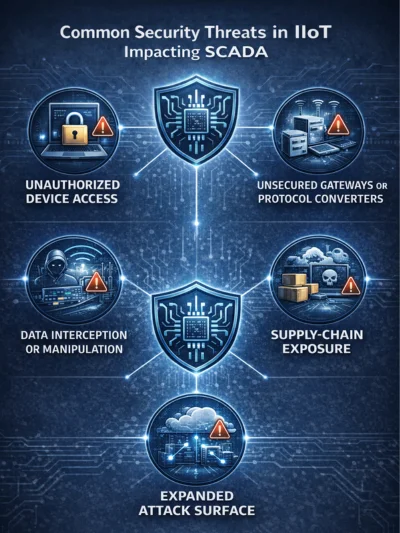
Common Security Threats in IIoT impacting SCADA
IIoT connectivity can add operational value, but it also increases the attack surface::
IIoT devices can support analytics, remote visibility, and performance monitoring. At the same time, new connected devices, gateways, and cloud-linked services can create new paths into industrial networks if they are not designed and governed correctly.
Threats commonly considered in IIoT-connected SCADA environments include:
| Threat | Description | Mitigation / Safe Design |
|---|---|---|
| Unauthorized device access | Devices with weak credentials or poorly controlled onboarding can be accessed by unauthorized users | Use strong authentication, controlled onboarding, and asset inventory |
| Unsecured gateways or protocol converters | Gateways bridging OT and external networks can be exploited | Segment networks, control approved communication paths, review interactions with SCADA |
| Data interception or manipulation | Data transmitted without strong security can be intercepted or altered | Implement encryption, secure protocols, and monitor communication |
| Supply-chain exposure | Third-party software, firmware, or unmanaged updates may introduce vulnerabilities | Approve software/firmware, control vendor updates, review third-party integrations |
| Expanded attack surface | Remote diagnostics and cloud-connected services create additional entry points | Segment networks, control device identity, document IIoT-SCADA interactions, enforce security policies |
SCADA Security Audit / Assessment
A security assessment should produce evidence, gaps, and a practical improvement roadmap::
A SCADA security audit or assessment is used to review the current security posture of the control environment. Its value comes from evidence: architecture review, asset verification, account review, configuration checks, and prioritized findings.
A typical assessment scope can include:
- Network architecture review, including zones, conduits, and remote access paths.
- Review of user accounts, password practices, access roles, and privileged sessions.
- Verification of server hardening, backup status, patch governance, and log retention.
- Assessment of vendor access controls and third-party connectivity.
- Review of incident response readiness and recovery procedures for SCADA systems.
The output should not stop at a list of issues. A useful assessment provides a practical roadmap with priorities, responsibilities, and staged actions that fit plant operations.
SCADA Backup & Disaster Recovery
Backup and recovery planning is a core part of SCADA protection, not an optional extra::
A SCADA environment may rely on many assets: server configurations, databases, historian data, alarm settings, driver configurations, engineering projects, and operator graphics. If these are not backed up and periodically verified, recovery after a cyber incident or system failure becomes slower and less predictable.
A practical backup and disaster recovery approach often includes:
- Scheduled backups for SCADA servers, historians, HMI projects, and configuration files.
- Offline or protected backup copies separated from normal operating access where approved.
- Documented recovery procedures for critical services and applications.
- Verification of restore capability through approved testing or drills.
- Clear recovery priorities for essential screens, alarms, communications, and historian functions.
Recovery planning should match business continuity requirements and the site’s operational priorities. A backup that has never been tested may not provide the level of assurance the site expects.
Why Contact Us for SCADA Security Services?
SCADA security services are most useful when they combine technical review with practical plant awareness::
Riyadh Al-Etqan Company (R-Aletqan) supports industrial clients with SCADA, PLC, DCS, and automation-related services where reliable protection and controlled change are important. For SCADA security, support quality is measured by clear findings, realistic priorities, and an approach that respects operations, maintenance windows, and site procedures.
A practical support scope may include:
- SCADA security review and architecture-level observations.
- Backup and recovery readiness checks for operational systems.
- Support for access control review, documentation, and change discipline.
- Review of integration paths between SCADA, PLCs, DCS, and remote access methods.
- Structured reporting with prioritized actions suitable for phased implementation.
Conclusion
scada security best practices should be treated as an ongoing discipline, not a one-time checklist. When security standards, management controls, audit routines, backup readiness, and change discipline are applied together, industrial sites are better prepared to reduce exposure and recover more effectively.
To review our capability presentation and discuss your SCADA security needs, view the company presentation and contact Riyadh Al-Itqan Company to book a discussion and request a quotation. View the presentation
FAQ
How often should SCADA security audits be performed?
The frequency should be defined by the site’s risk profile, operational criticality, and change activity. Many facilities review security at regular intervals and after major architecture, software, access, or remote connectivity changes. The exact schedule should be based on approved site policy.
Can SCADA security prevent downtime?
SCADA security can reduce the likelihood and impact of incidents that may lead to downtime, but it should be treated as risk reduction rather than an absolute guarantee. Strong segmentation, controlled access, monitoring, backup, and recovery readiness help improve resilience.
Difference between IT security and SCADA/ICS security?
IT security often prioritizes confidentiality, while SCADA/ICS security must also protect safety, availability, process continuity, and controlled response. The controls may overlap, but OT environments require methods that fit industrial operations and maintenance constraints