
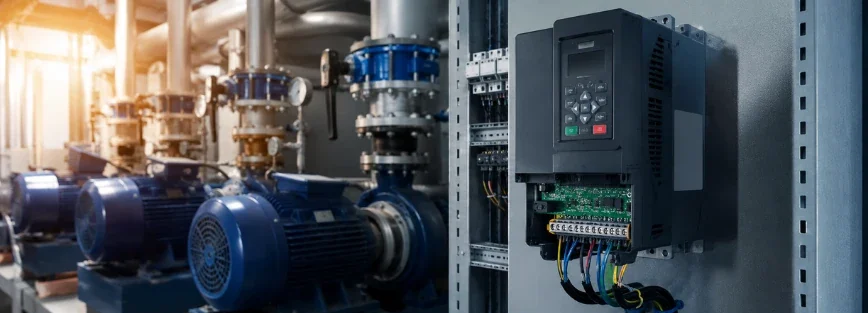
What is a VFD and how does it work is a question that comes up frequently in industrial plants where motor performance, energy efficiency, and process control are critical. In many facilities across Saudi Arabia and the wider Gulf region, motors are still running at fixed speed regardless of actual demand — leading to energy waste, higher mechanical stress, and reduced system flexibility. This is a real operational challenge, particularly in environments where ambient temperatures regularly exceed 45°C and dust accumulation is a constant maintenance concern.
This is where variable frequency drive technology becomes essential in modern automation systems. Understanding how this technology is applied, where it is used, and what factors affect its performance is key before selecting or installing a VFD in any industrial system.
What is a vfd and how does it work
What is a VFD
A variable frequency drive (VFD) is an electronic device used to control the speed of an AC motor by adjusting the frequency and voltage supplied to it. It allows motors to operate at variable speeds instead of running at a fixed speed, which improves efficiency, process control, and overall system performance in industrial applications.
In technical terms, a variable frequency drive (VFD), also called a variable speed drive (VSD), is an electronic drive system used to control an AC motor more precisely than direct-on-line starting allows. According to IEC 61800-5-1, an adjustable-speed power drive system includes the power conversion stage, control module, and motor interface. In industrial applications, VFDs are widely used in pumps, fans, conveyors, compressors, grinders, and kilns.
How a VFD works
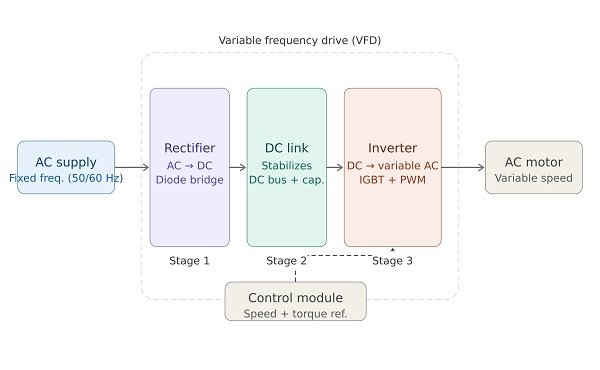
At a practical level, what is a VFD and how does it work can be understood through three main stages: rectifier, DC link, and inverter. First, the rectifier converts fixed-frequency AC power from the grid into DC. Then the DC link smooths and stabilizes this energy. Finally, the inverter uses IGBT switching and PWM (pulse width modulation) to generate a controlled AC output with variable voltage and frequency supplied to the motor.
This process is important because the speed of an AC motor is directly related to the frequency of the electrical supply. By controlling frequency electronically, a VFD allows smooth acceleration, deceleration, and variable speed operation, improving process control compared to fixed-speed systems.
Why VFDs are used in industrial applications
From a real industrial perspective, VFDs are not used just for speed control — they are used because most industrial processes do not operate at constant demand all the time. In many plants, motors driving pumps, fans, and conveyors are oversized for peak conditions while actual demand changes continuously. Without a VFD, excess energy is wasted or controlled mechanically through valves and dampers, which is inefficient and creates additional stress on the system.
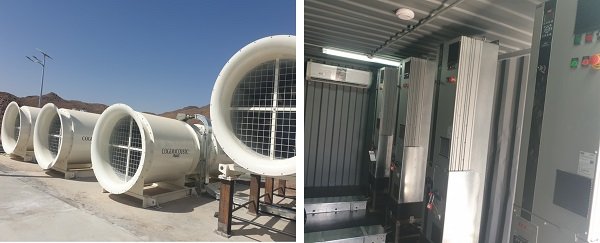
A practical example is the commissioning of four Danfoss FC-102 units, each rated at 250 kW, installed in ventilation fans for the NEUM City SHAJV tunnel project in 2024. By using variable frequency drives, fan speed was matched to real-time airflow requirements — reducing energy consumption and mechanical wear on the fan assemblies. This demonstrates why VFD selection and proper commissioning are inseparable from long-term system performance.
By matching motor speed to actual process demand, a pump does not need to run at full flow if the system only requires partial load, and a fan can adjust airflow instead of wasting energy through mechanical restriction. Beyond energy savings, VFDs also allow smooth ramp-up and ramp-down, reducing mechanical shock on couplings and gearboxes, and enabling fine-tuned process stability in systems like water treatment plants, HVAC, and production lines.
Key Benefits of a VFD in Industrial Applications
A variable frequency drive provides several important advantages in industrial applications by improving how AC motors are controlled and operated. Instead of running motors at constant speed, a VFD allows the speed to match the actual process demand, which leads to better efficiency, performance, and equipment protection.
VFD Benefits:
- Improved energy efficiency by matching motor speed to actual load demand
- Reduced mechanical stress through smooth starting and stopping of motors
- Lower maintenance requirements and extended equipment lifetime
- Better process control with precise speed regulation
- Improved system stability in variable load applications
Common Industrial Applications of VFDs
Variable frequency drives are widely used across industrial sectors wherever motor speed control and process efficiency are required. Their ability to adjust motor speed based on demand makes them suitable for a wide range of variable load applications.
- Pumps: VFDs are commonly used in water and process pumping systems to control flow and pressure using VFD solutions for pumps and fans instead of mechanical throttling methods.
- Fans and HVAC systems: In ventilation and air handling systems, VFDs regulate airflow based on temperature or pressure demand, improving energy efficiency.
- Conveyors: VFDs help control conveyor speed in production lines, ensuring smooth material handling and synchronized operation.
- Compressors: They are used to maintain stable pressure levels and reduce energy consumption during partial load operation.
- Industrial processes (kilns, mixers, crushers): VFDs provide controlled speed variation to match process requirements and reduce mechanical stress on equipment.
VFD vs Direct-On-Line (DOL) Starting
Direct-On-Line (DOL) starting is the simplest method of starting an AC motor, where the motor is connected directly to the power supply without any speed control. In this method, the motor receives full voltage instantly and starts at its natural speed, which results in a very high starting current and sudden mechanical stress on the system.
In contrast, a variable frequency drive (VFD) provides controlled motor starting by gradually increasing voltage and frequency. This allows smooth acceleration instead of sudden startup, reducing electrical and mechanical stress on the motor and connected equipment.
- Starting current: DOL has high inrush current, while VFD limits starting current.
- Speed control: DOL operates at fixed speed, while VFD allows variable speed operation.
- Mechanical stress: DOL causes sudden torque shock, while VFD provides smooth ramp-up and ramp-down.
- Energy efficiency: DOL runs at full speed regardless of demand, while VFD adjusts speed based on load requirements.
- Application suitability: DOL is suitable for simple, low-cost applications, while VFD is used in systems requiring control, efficiency, and protection.
Key considerations when using a VFD
When implementing a variable frequency drive in an industrial system, several technical factors should be considered to ensure reliable performance and long-term stability. Proper selection and installation are essential for avoiding operational issues.
- Motor and VFD sizing must be correctly matched to avoid overload or underperformance. Proper system design requires correct evaluation of motor load and operating conditions. More details are explained in how to select a VFD for a motor.
- Cable length between the VFD and motor can affect performance and may require special design considerations
- In Gulf region installations, high dust, coastal humidity, and extreme heat directly affect enclosure selection and derating requirements — drives may need 10–20% derating unless the correct IP rating and cooling method are specified from the start.
- Harmonic distortion may occur in electrical systems and should be evaluated in sensitive installations
- Proper grounding and installation practices are important to ensure stable and safe operation
Ready to Apply This in Your Facility?
Understanding what a VFD is and how it works is the first step — but translating that understanding into a correctly sized, properly installed, and reliably commissioned drive system is where the real engineering value lies. Whether the application involves tunnel ventilation fans, process pumps, or industrial conveyors, the selection criteria, environmental derating, and commissioning requirements must be addressed as a complete system — not as isolated decisions.
For industrial facilities in Saudi Arabia that need engineering support with VFD selection, sizing, installation, or commissioning, Riyadh Al Etqan Co. brings hands-on field experience
FAQ
1. What industries benefit the most from using a VFD?
Industries with variable load demand benefit the most from VFDs, such as water treatment, oil and gas, HVAC systems, manufacturing plants, and food processing. These industries rely on precise motor control to optimize energy use and process stability.
2. Can a VFD work without a PLC?
Yes, a VFD can operate independently using local control (keypad or analog signals). However, in modern industrial automation systems, VFDs are often integrated with PLCs for centralized control, monitoring, and automated process adjustments.
3. What causes a VFD to fail in industrial environments?
Common causes include overheating, poor ventilation, dust accumulation, electrical surges, incorrect sizing, and improper installation. Environmental conditions and maintenance quality also play a major role in long-term reliability.
4. Are VFDs suitable for high-torque applications?
VFDs can be used in high-torque applications, but proper sizing and motor selection are critical. Some heavy-duty loads like crushers or large conveyors may require vector control or specialized drive configurations for stable performance.