Industrial PLC programming is the foundation of modern industrial automation, used to control machines, production lines, utilities, and process systems across manufacturing facilities. In Saudi Arabia, reliable automation depends not only on writing control logic, but also on accurate I/O configuration, safe commissioning, HMI/SCADA integration, and stable communication between field devices and control systems.
Modern PLC systems are built around the IEC 61131-3 programming standard, which includes Ladder Diagram, Structured Text, Function Block Diagram, and Sequential Function Chart. However, real industrial performance issues are rarely caused by software alone. In operating plants, problems often appear at the intersection of PLC logic, field wiring, network communication, instrumentation signals, and real operational conditions — making diagnostics and system understanding a critical part of every automation project.
What is Industrial PLC Programming?
Industrial PLC programming is the process of designing, writing, and configuring control logic used in programmable logic controllers (PLCs) to automate industrial machines, production lines, and process systems. It defines how a PLC interprets input signals from field devices such as sensors and switches, processes them according to a programmed logic, and generates output commands to control actuators like motors, valves, and relays.
In industrial automation systems, this programming plays a critical role in ensuring precise, reliable, and real-time control of operations across manufacturing plants, utilities, and infrastructure projects.
How PLC Systems Work
PLC systems work by continuously reading input signals from field devices such as sensors, switches, and transmitters, processing these signals through programmed logic inside the controller, and then generating output commands to operate industrial equipment like motors, valves, and actuators.
The operation follows a continuous scan cycle that includes three main steps: reading inputs, executing the control program, and updating outputs. This cycle repeats in real time, allowing the controller to respond instantly to changes in the industrial process.
Because of this real-time behavior, PLC systems are widely used in automation environments where accuracy, speed, and reliability are critical for stable industrial operation.
PLC Programming Languages and Standards
PLC programming is based on the IEC 61131-3 standard, which defines the main languages used in industrial automation systems.
The most commonly used languages are:
Ladder Diagram (LD): Used for basic control logic and motor control, designed in a format similar to electrical circuits.
Structured Text (ST): A text-based language used for complex logic, calculations, and data handling.
Function Block Diagram (FBD): Uses graphical blocks to build reusable control functions, commonly used in process control.
Sequential Function Chart (SFC): Used for step-by-step processes in sequential operations and batch systems.
Key Industrial Applications of PLC Programming
PLC programming is used across many industrial sectors where precise, automated, and reliable control is required. It plays a critical role in improving efficiency, safety, and consistency of operations.
In manufacturing systems, it controls production lines, conveyor belts, and robotic processes. In water and wastewater treatment plants, it manages pump sequencing, level control, and filtration operations. In the oil and gas industry, it is used for process control, monitoring, and safety interlocks. It is also widely applied in HVAC systems for temperature and energy control, as well as in packaging and material handling systems for automation and speed optimization
Common issues in industrial PLC programming
1) Incorrect I/O Mapping
One of the most common issues occurs when the program logic is correct but the input/output mapping is wrong. The PLC may read incorrect sensor signals, control the wrong output, or apply incorrect scaling, leading to misleading system behavior. This is why I/O verification should always come before modifying logic.
For teams dealing with this kind of issue, the most useful internal starting points are PLC fault finding techniques and PLC installation troubleshooting and maintenance.
2) Communication Failures (PLC, HMI, SCADA)
Many PLC problems are actually communication issues between controllers, HMI, or SCADA systems. Poor configuration can lead to delayed updates, missing alarms, or incorrect data visibility even when the PLC is functioning normally
3) Grounding and Wiring Problems
Electrical grounding issues, loose wiring, or poor panel bonding can cause unstable signals, noise, or random faults. These physical issues often appear as software problems but originate from installation quality.
That is especially relevant when the site is also dealing with PLC panel earthing or mixed-power cabinets carrying drives, starters, and sensitive I/O in the same enclosure.
4) Lack of Version Control
Without proper backup and version tracking, it becomes difficult to confirm which PLC program is actually running. Undocumented changes or emergency edits often lead to confusion during troubleshooting.
5) Weak Program Structure
Poorly structured logic, missing diagnostics, and unclear interlocks make fault detection difficult. A good PLC program should not only run correctly but also clearly indicate when and where a problem occurs.
What to Check First Before Changing the Program
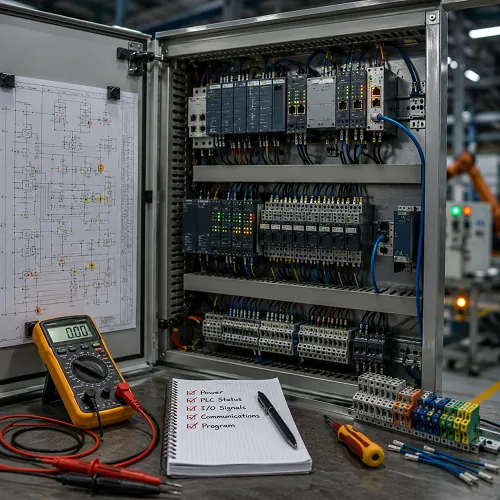
Do not modify PLC logic before identifying the real fault condition. Check the machine symptom, controller status, alarm history, recent changes, and whether the issue is in a single module, communication path, or the whole system.
Then confirm if the problem is in the program or in the field, since many faults come from wiring, faulty I/O, incorrect scaling, communication issues, or grounding problems.
A quick checklist should include:
- Controller status and diagnostics
- Recent program changes
- I/O and module faults
- Field power and signals
- Grounding and panel bonding
- Network status (HMI, SCADA, drives)
- Interlocks and sequence conditions
- Backup vs. running program
What Procurement Teams Should Really Compare
When evaluating a PLC supplier Saudi Arabia, a PLC panel manufacturer Saudi Arabia, or a PLC SCADA integration company Saudi Arabia, the focus should go beyond CPU models and delivery time. Standards like ISA-95 and ISA-112 emphasize system architecture, integration, and lifecycle support rather than hardware only.
Key evaluation points include:
- Full scope delivery (PLC supply, panels, programming, commissioning)
- Clear documentation (I/O lists, tags, alarms, communications)
- Reliable integration with HMI/SCADA and plant networks
- Support for diagnostics, backups, and post-commissioning changes
- Ability to troubleshoot real field issues
Whether comparing a Siemens PLC supplier Riyadh shortlist or an Allen-Bradley PLC supplier Saudi Arabia shortlist, the decision should be based on engineering capability, documentation quality, and integration expertise rather than brand or hardware alone. IEC 61131-3 provides the common technical foundation across PLC platforms.
When to Bring in a Specialist Team
A specialist team is required when issues extend beyond a single logic or I/O point, such as repeated faults, SCADA mismatches, communication loss, grounding problems, or unreliable backup programs.
It is also essential for full project implementation, including new production lines, system upgrades, or integrated automation projects that require complete engineering support.
In such cases, it is recommended to involve a qualified automation partner such as Riyadh Al Etqan to ensure proper system reliability and integration.
FAQ
What should be checked first in industrial PLC programming troubleshooting?
Start with controller status, diagnostic history, recent changes, I/O health, and field wiring before rewriting logic. Modern PLC diagnostics are designed to help identify the location and cause of faults quickly.
Why do PLC issues often turn out to be wiring or grounding problems?
Because program execution depends on real input signals, healthy outputs, and stable electrical installation. Rockwell’s grounding guide requires proper bonding, enclosure grounding, and reliable electrical contact to control EMI and grounding issues.
When does a PLC problem become a SCADA integration problem?
When the issue involves tag exchange, remote commands, alarms, historian behavior, or HMI visibility rather than only local control logic. ISA112 describes SCADA as a combination of hardware and software used to send commands and acquire data for monitoring and control, and it promotes best practices for designing and maintaining these systems.
When should a plant call a specialist instead of troubleshooting in-house?
When faults repeat, safety or interlock logic is involved, communication architecture is unstable, or nobody can confirm the correct running version of the program. Those are signs the problem has moved from routine maintenance into engineering and system-integration territory.