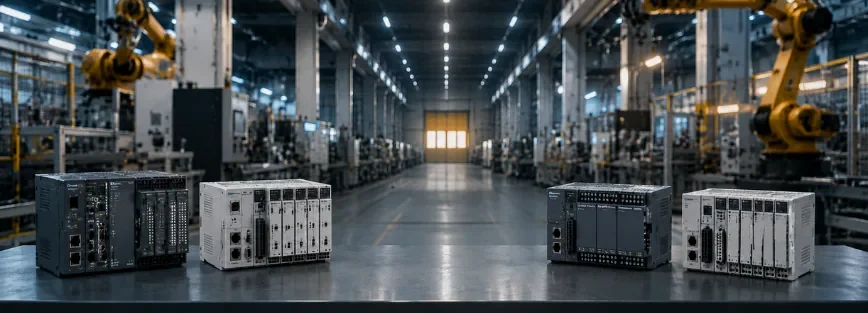
A Saudi-based automation provider should be able to supply PLC hardware, program the control logic, integrate HMI and SCADA, support commissioning, and remain available for troubleshooting after handover. For buyers comparing a PLC supplier Saudi Arabia plants can rely on, the right choice is usually the one with stronger engineering, clearer commissioning scope, better documentation, and more dependable support, not simply the lowest commercial offer. The referenced PLC solutions page explicitly lists supply of complete PLC panels, PLC and SCADA engineering, HMI design, startup and commissioning, remote and on-site troubleshooting, upgrades, and annual maintenance support.
That matters because PLC projects are not just hardware purchases. IEC 61131-3 defines the programming languages and structural rules used for programmable controllers, ISA-95 focuses on the interface between control functions and enterprise functions, and NIST’s OT guidance emphasizes that programmable industrial systems must be managed with reliability, safety, and security in mind. In practice, that means a weak supplier can still deliver a controller, while a strong supplier reduces risk across programming, field I/O, integration, and lifecycle support.
What a reliable PLC supplier should actually provide
A serious supplier should be able to support more than product selection. The PLC solutions page shows a scope that includes complete PLC panels, small- to large-scale automation projects, PLC and SCADA engineering, HMI design, startup and commissioning, technical support, troubleshooting, and upgrade work. For buyers, that is a useful starting point because it means the supplier is set up to handle the project from concept through post-startup support instead of stopping at delivery.
That is why the first page worth checking is programmable logic controllers (PLCs). A supplier that can only quote PLC hardware but cannot define programming scope, integration scope, or commissioning method usually shifts risk back to the plant team later. If the project also needs operator visibility and remote monitoring, the review should include Monitoring System (SCADA, HMI) from the start.
Engineering depth should come before model numbers
A weak buying process starts with brand or CPU family. A stronger buying process starts with the application: I/O count, analog accuracy, sequence complexity, network topology, redundancy needs, remote I/O, alarm handling, historian links, and interface requirements to higher-level systems. ISA-95 exists specifically to define and reduce the risk, cost, and errors associated with interfaces between control functions and other enterprise functions. That means a good supplier should be able to discuss architecture and boundaries clearly before recommending products.
This is especially important when procurement is comparing shortlists such as a Siemens PLC supplier Riyadh option, an Allen-Bradley PLC supplier Saudi Arabia option, or a broader PLC SCADA integration company Saudi Arabia option. The right comparison is not only which brand is offered, but whether the supplier can explain how the PLC will be programmed, diagnosed, integrated, and supported in the actual plant environment. IEC 61131-3 supports that view because it standardizes the programming framework rather than tying good engineering to a single vendor platform.

Commissioning scope is one of the biggest buying criteria
Many buyers compare hardware and underweight commissioning. That is usually a mistake. The PLC solutions page specifically lists startup and commissioning, while the site’s own PLC programming and industrial automation projects pages position programming and implementation as engineering work rather than simple device setup. A usable commissioning scope should cover FAT or simulation where needed, I/O checks, communication checks, alarm verification, HMI validation, startup support, and as-left backups.
Diagnostics support is also part of commissioning quality. Siemens’ diagnostics overview for S7-1200 and S7-1500 states that system diagnostics helps faults be identified in plain text and supports faster error detection and rectification. Rockwell’s fault manual similarly treats major, minor, and I/O faults as structured controller events, not random nuisances. A supplier that understands commissioning should therefore be able to explain how faults will be handled after startup, not only how the CPU will be wired.
Documentation quality decides how supportable the system will be later
A project can start successfully and still become difficult to maintain if the final documentation is weak. Good documentation should include the I/O list, tag mapping, network drawing, alarm list, HMI references, backup method, as-left software revision, and a clear record of changes made during startup. The PLC service page already frames lifecycle support broadly, including maintenance and upgrades, which only works reliably when the final system state is documented.
For practical field use, this is where supporting technical pages such as PLC fault finding techniques, PLC not communicating, and PLC installation troubleshooting and maintenance become valuable. They reinforce the same point: a control system becomes easier to troubleshoot when the original engineering and as-left data are clear.
Grounding and panel quality matter more than many buyers expect
Not every PLC problem is a programming problem. Rockwell’s industrial automation wiring and grounding guidelines state that the chassis, back panel, and enclosure should have a good electrical connection and that paint or other non-conductive finishes should be removed where grounding contact is made. In real projects, poor bonding and weak panel practice can create unstable signals, communication issues, and nuisance faults that later get blamed on the PLC program.
That is one reason buyers should evaluate the supplier’s panel and installation discipline, not only its product catalog. If the scope includes new control cabinets or retrofit work, pages such as PLC panel earthing and pre-commissioning checklist for instrumentation are relevant internal checkpoints because they connect panel workmanship and field readiness to control reliability.
After-sales support should be judged as a technical service, not a promise
After-sales support is one of the clearest separators between a seller and an engineering partner. The PLC solutions page explicitly offers annual maintenance contracts, remote and on-site troubleshooting, and modifications and upgrades. That is valuable only if the supplier also has the processes to support changes safely and consistently. IEC 62443-2-4 is relevant here because it defines security-related process requirements that IACS service providers can offer during integration and maintenance activities, while NIST’s OT guidance emphasizes that support and maintenance in OT environments have to respect reliability, safety, and security together.
In practical terms, buyers should ask: How are backups handled? How are remote changes approved? How are diagnostics reviewed? How are documentation updates maintained after modifications? If those questions are unanswered, the supplier may be strong in quotation speed but weak in lifecycle support.
A practical buyer checklist for Saudi industrial teams
Before choosing a PLC supplier Saudi Arabia project teams should confirm five things. First, the supplier can explain the control architecture and interface boundaries clearly. Second, the supplier can define commissioning scope, not just delivery scope. Third, the supplier can issue useful documentation and backups. Fourth, the supplier has a workable diagnostics and support model. Fifth, the supplier treats integration and maintenance as engineering work, not informal site edits. Those criteria align with IEC 61131-3, ISA-95, NIST OT guidance, and the service scope shown on the referenced PLC page.
A practical next step is to review programmable logic controllers (PLCs), then compare how that scope connects to Monitoring System (SCADA, HMI), PLC programming, and industrial automation projects. That usually gives buyers a better picture of engineering depth than a catalog comparison alone.
FAQ
What should buyers compare first when choosing a PLC supplier?
Start with engineering depth, commissioning scope, documentation quality, diagnostics capability, and after-sales process. Those are the factors most directly tied to reliability once the system is live.
Why is commissioning scope so important?
Because startup and commissioning are where I/O issues, communication mismatches, alarm problems, and operator-interface gaps are usually discovered. A supplier that defines commissioning well reduces startup risk.
Why should grounding and panel work matter in a PLC buying decision?
Because poor grounding and weak panel workmanship can create unstable system behavior that later looks like a software problem. Rockwell’s grounding guidance specifically treats bonding and enclosure connection quality as essential installation practice.
When does a PLC supplier become a PLC integration partner?
When the supplier can support not only supply, but also programming, SCADA or HMI links, diagnostics, commissioning, upgrades, and structured maintenance processes after handover.
If your factory or utility needs a PLC supplier Saudi Arabia teams can trust for supply, programming, or integration, start with programmable logic controllers (PLCs), connect the wider operator and monitoring layer through Monitoring System (SCADA, HMI), or use contact us to book a PLC consultation and request a quotation. For direct coordination, call (+966) 920012931.