

Types of alarms in SCADA could be the difference between catching a critical plant issue early or facing unexpected downtime. A well-designed SCADA alarm management system ensures operators notice abnormal conditions before they grow into wider operational problems. In industrial environments, SCADA alarms do more than display warnings on a screen—they support response timing, maintenance coordination, and operational decision-making.
This article explains SCADA alarm types, the difference between alarms and events, common alarm problems, configuration guidance, testing procedures, and practical ways to improve alarm performance in a plant environment.
What Are Alarms in SCADA Systems?
In SCADA systems, alarms are operational notifications that indicate abnormal or attention-worthy conditions. An alarm is generated when a measured value, equipment status, or logical condition crosses a defined threshold or enters an abnormal state.
SCADA alarms are used to support:
• Operator awareness of abnormal process or equipment conditions.
• Faster response to faults, trips, or communication loss.
• Prioritization of plant issues based on urgency and consequence.
• Historical review of events and operator response actions.
A well-designed alarm should be meaningful, timely, and actionable. Poorly configured alarms can create unnecessary noise and reduce operator effectiveness.
Read About: SCADA system for electrical substation: A Complete Guide
Types of Alarms in SCADA Systems
Types of alarms in SCADA systems are used to classify and organize alerts so operators can quickly understand and respond to different plant conditions. These alarms cover process, equipment, communication, and system issues. The table below summarizes the main SCADA alarm types and their function in industrial operations.
| Alarm Type | Description | Purpose in Industrial Plants |
|---|---|---|
| High / Low Analog Alarms | Triggered when process values like pressure, temperature, level, or current exceed defined high or low limits | Detect early deviations in process conditions before they become critical |
| High-High / Low-Low Alarms | More critical thresholds beyond normal high/low limits | Indicate dangerous conditions requiring immediate operator action or shutdown |
| Digital Status Alarms | Based on equipment states such as ON/OFF, trip signals, or fault indications | Monitor equipment health and detect abnormal state changes |
| Communication Alarms | Generated when PLCs, RTUs, or field devices lose communication or send bad-quality data | Ensure system connectivity and detect network or device failures |
| System Alarms | Related to SCADA infrastructure like servers, historian, time sync, or application services | Maintain system reliability and detect platform-level issues |
| Advisory / Warning Alarms | Non-critical alerts that indicate conditions needing attention but not immediate action | Support operator awareness without increasing alarm pressure |
Read About: What is a SCADA Attack? Risks, Impact & Industrial Protection
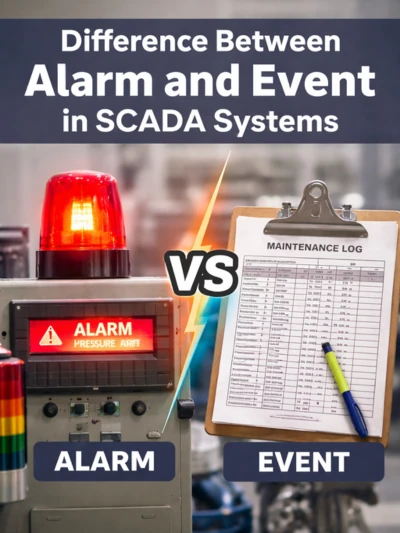
Difference Between Alarm and Event in SCADA Systems
The difference matters because not every event should demand operator action:: In SCADA environments, alarms and events are related but not identical. An event is generally any recorded change or action in the system, while an alarm is a specific condition that requires operator attention.
The distinction can be summarized this way:
- An alarm is actionable: it signals an abnormal condition that requires awareness, acknowledgement, or response.
- An event is informational: it records a change such as login activity, setpoint update, mode change, or normal equipment state transition.
- Too many events displayed as alarms can overwhelm operators and reduce the value of true alarms.
- Separating alarms from events improves clarity during troubleshooting and shift handover.
A strong SCADA design usually defines which conditions belong in the alarm list and which should remain only in event history. That separation supports cleaner screens and better operator focus.
Read about: 8 Key SCADA Security Best Practices for Industrial Teams
Common SCADA Alarms Found in Industrial Plants
The alarm list should reflect real plant conditions, not generic screen design::
The alarms visible in a SCADA system usually reflect the plant process, the electrical or automation equipment connected to the system, and the site’s approved alarm philosophy. For that reason, one plant may display a different alarm set from another, even if both use similar software platforms.
Operators commonly find alarms related to:
- Process deviations such as high pressure, low flow, high temperature, or abnormal tank level.
- Electrical conditions such as breaker trips, relay indications, motor faults, or power loss.
- Automation and communication issues such as PLC faults, bad-quality tags, or network link loss.
- System health conditions such as SCADA service failure, historian interruption, or time sync problems.
The most useful alarm lists are reviewed periodically to ensure they still match the actual operating needs of the facility.
Common SCADA Alarm Problems
Most alarm problems are caused by poor configuration, weak review practices, or unmanaged system changes::
SCADA alarm problems often become visible during upsets, maintenance, or troubleshooting. At that moment, poor alarm quality can make it harder for the operations team to identify what really matters.
Common SCADA alarm problems include:
- Alarm flooding, where too many alarms appear in a short time and overwhelm the operator.
- Standing alarms that remain active for long periods and reduce attention to new problems.
- Nuisance alarms that repeat frequently without useful action value.
- Missed alarms caused by bad tag quality, disabled logic, or notification path failures.
- Poor alarm priority assignment that makes minor conditions look as urgent as critical ones.
These issues should be reviewed through documented alarm performance checks, not by isolated screen edits only. A plant usually benefits more from an organized alarm review than from one-off configuration changes.
SCADA Alarm Configuration Guidelines for Industrial Plants
Configuration should support clarity, actionability, and consistency across the plant:: larm configuration is more effective when it follows written rules rather than user preference. A configuration guideline should define what deserves an alarm, how priorities are assigned, and how alarms are displayed and acknowledged.
Practical configuration guidelines often include:
- Use clear alarm text that identifies the equipment, condition, and location.
- Assign priorities based on consequence, urgency, and required operator response.
- Set alarm limits and delays carefully so normal fluctuations do not generate nuisance alarms.
- Keep acknowledgement rules consistent across similar equipment and areas.
- Document alarm logic, setpoints, and reasons for important configuration changes.
Many industrial sites also align their alarm practices with an alarm management philosophy so that alarm settings remain consistent over time and across departments.
SCADA Alarm Testing Procedures for Industrial Operations
Testing is necessary because an alarm that exists in configuration is not automatically proven in operation:: SCADA alarm testing should confirm that the alarm is generated, displayed, logged, and, where required, routed to the correct notification channel. Testing should always follow approved operating procedures and safe methods.
A practical alarm testing procedure often includes:
- Select a controlled test point or approved simulation method.
- Confirm the trigger condition and expected alarm text before testing.
- Verify that the alarm appears on the correct screen with the correct priority.
- Check acknowledgement behavior and event logging.
- Confirm related notifications or escalation paths where they are part of the design.
- Record the result, the test method used, and any deviations found.
Documented testing helps prevent hidden failures in alarm presentation, event recording, or notification routing.
Best Practices for SCADA Alarms
Good alarm performance depends on review discipline, not only initial configuration:: Best practices for SCADA alarms focus on keeping the alarm system useful throughout the life of the plant. That means reviewing performance, reducing nuisance conditions, and maintaining consistency after changes and expansions.
Best practices commonly include:
- Maintain an alarm philosophy or alarm configuration guideline for the site.
- Review alarm history regularly to identify standing alarms and recurring nuisance alarms.
- Keep alarm text, priority, and acknowledgement behavior consistent across similar assets.
- Use change control for edits to limits, delays, alarm logic, or notification paths.
- Train operators and maintenance teams on alarm meaning, alarm priority, and escalation expectations.
A good alarm system is usually the result of continuous refinement, not a one-time engineering task.
How to Handle SCADA Alarm Issues in Industrial Plants?
If your site is facing alarm flooding, missing notifications, poor alarm priorities, or recurring nuisance alarms, a structured review can help identify where the configuration or maintenance process needs improvement. Riyadh Al-Itqan Company (R-Aletqan) supports industrial clients with SCADA, PLC, DCS, and automation-related services where alarm quality, communication reliability, and documentation discipline matter.
A practical support scope can include:
- Review of alarm lists, priorities, and configuration consistency.
- Alarm testing support under approved site procedures.
- Troubleshooting of tag quality, communication issues, or notification path failures.
- Documentation support for alarm logic changes and maintenance records.
Conclusion
types of alarms in scada should be selected, configured, and reviewed with care because alarms influence how quickly teams notice and respond to abnormal conditions. When alarm logic, priorities, testing, and maintenance are handled properly, the SCADA system becomes more useful and the plant is better prepared to avoid avoidable operational delays.
To review our capability presentation and discuss your SCADA alarm needs, view the company presentation and contact Riyadh Al-Itqan Company to book a discussion and request a quotation. View the presentation
FAQ
How can SCADA alarms prevent production downtime?
SCADA alarms can help reduce production downtime by giving operators earlier visibility of abnormal conditions, faults, communication loss, or equipment trips. They do not eliminate all downtime risk, but they support faster response and better troubleshooting when configured and maintained properly.
What tools can I use to monitor SCADA alarms effectively?
Effective monitoring usually combines the SCADA alarm list, alarm history, event logs, historian trends, and where applicable, approved notification channels and reporting tools. The right tool set depends on the system architecture and the site’s operating procedures.
How do I reduce alarm flooding in SCADA systems?
Alarm flooding is usually reduced by reviewing priorities, removing nuisance alarms, applying proper delays and limits, separating events from alarms, and maintaining a documented alarm philosophy. A structured alarm review is normally more effective than isolated screen changes.