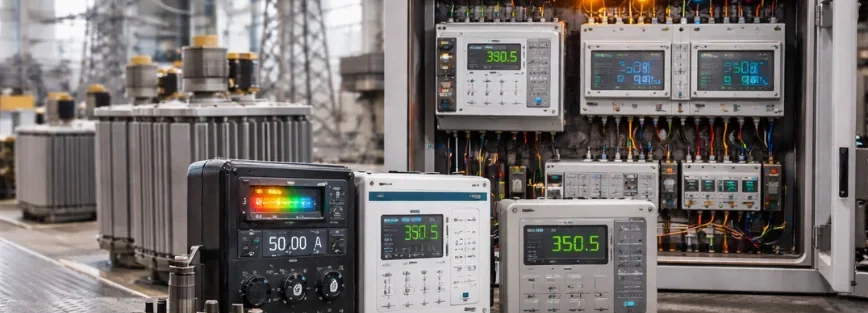
Types of Protection Relay in Power System are crucial for ensuring fault detection, system stability, and equipment safety. In industrial plants, substations, and utility systems, protection relays detect abnormal electrical conditions and trigger the appropriate response through circuit breakers or other protection schemes. A solid understanding of relay basics, relay types, Main 1 and Main 2 arrangements, and routine testing and maintenance helps teams minimize outages, limit equipment damage, and boost operational confidence.
This article explains these fundamentals in a practical way for engineers, maintenance teams, and plant decision-makers.
Basics of Protection Relays
A protection relay is a device that monitors electrical conditions such as current, voltage, frequency, impedance, phase angle, or differential values and then issues a trip or alarm command when those values indicate a fault or an abnormal operating condition. Its purpose is not simply to detect any change. Its purpose is to detect conditions that require action and to do so with the correct speed, selectivity, and reliability.
In practical terms, protection relays are used to help protect feeders, transformers, motors, generators, busbars, and transmission or distribution lines.
Core protection objectives normally include:
- Fast fault detection where speed is required.
- Selectivity, so only the affected part of the system is isolated where possible.
- Sensitivity, so the relay can detect the relevant fault level.
- Reliability, so the relay operates when required and does not operate without cause.
Types of relays in power system applications are usually selected according to the protected equipment, the fault level, the system earthing method, and the required protection philosophy.
Types of Protection Relay in Power System
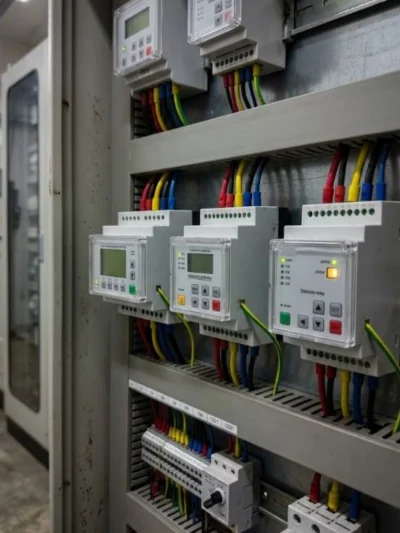
Types of Protection Relay in Power System depend on the protection function and the part of the power system being protected. There are many ways to classify protection relays. They can be grouped by technology, by operating principle, or by protection function. In modern practice, the most useful approach is usually by protection function. The common types of protection relays, their functions, and applications are summarized in the table below.
| Type of Relay / Aspect | Details |
|---|---|
| Overcurrent Relays | For phase fault and earth fault protection |
| Differential Relays | For transformers, generators, motors, and busbars |
| Distance Relays | For transmission and some line protection schemes |
| Under/Over Voltage Relays | For voltage supervision and protection |
| Under/Over Frequency Relays | For frequency-related abnormal conditions |
| Directional Relays | Where fault direction matters for coordination |
| Thermal Relays / Motor Protection Functions | For rotating equipment |
| Reverse Power Relays, Synch-Check Relays, and Special-Purpose Relays | For specific system conditions |
| Evolution by Technology | Older schemes used electromechanical relays, later static relays, today digital and numerical relays combine multiple protection functions, event recording, disturbance data, and communication features in one device |
DMT and IDMT Relays Explained
Time-current characteristics matter because protection is not only about detecting a fault, but also about coordinating the response. DMT usually refers to Definite Minimum Time or definite time behavior, where the relay operates after a set time delay once the pickup condition is reached.
IDMT refers to Inverse Definite Minimum Time, where the relay operating time becomes shorter as the fault current increases, but still approaches a minimum limit according to the selected characteristic curve.
In practical protection studies, this means:
- A definite-time relay gives a fixed operating delay after pickup.
- An IDMT relay gives faster operation for higher fault levels and supports grading with upstream and downstream relays.
- IDMT curves are commonly used in feeder protection and coordination studies where selectivity is required.
The exact curve type, time multiplier setting, and pickup level should be selected through coordination studies and according to the protected equipment, system configuration, and owner requirements.
Main 1 and Main 2 Protection Philosophy
Main 1 and Main 2 are used where high reliability and security of supply require more than one primary protection path::
Main 1 and Main 2 protection generally refer to two independent primary protection systems applied to the same asset or circuit. This approach is common in important lines, transformers, or substation assets where protection redundancy is required by the owner or utility standard.
A typical Main 1 / Main 2 philosophy aims to provide:
- Independent fault detection paths.
- Separate hardware, logic, or communication channels where required.
- Improved availability of protection if one scheme is isolated for testing or maintenance.
- Stronger reliability in critical electrical networks.
Main protection should not be confused with backup protection. Main 1 and Main 2 are both primary schemes. Backup protection is usually intended to clear the fault if the primary protection or breaker fails.
Common Problems and Troubleshooting in Protection Relays
Relay problems are often linked to settings, wiring, CT/VT circuits, communication, or maintenance condition::
When protection relays misoperate, fail to operate, or produce repeated alarms, the issue may come from more than the relay hardware itself. The fault may be in the measurement inputs, the logic settings, the trip circuit, the breaker interface, or the communication and event recording path.
Common relay-related issues include:
- Incorrect settings or unapproved settings changes.
- CT polarity errors, CT saturation issues, or open-circuit secondary concerns.
- VT fuse failure or incorrect voltage input conditions.
- Trip circuit supervision alarms or incomplete breaker interface checks.
- Communication failures affecting SCADA visibility or relay engineering access.
- Poor event synchronization or missing disturbance records.
Troubleshooting should be systematic. It should compare actual measurements, relay indications, settings files, wiring drawings, event logs, and recent maintenance history before any conclusion is made.
Safety Precautions While Working with Protection Relays
Relay work should always be approached as protection work, control work, and electrical work at the same time::
Protection relay work is safety-sensitive because relay maintenance or testing may affect tripping logic, breaker operation, or the protection availability of energized assets. That is why safety precautions must be aligned with the site’s electrical safety rules and approved switching or isolation procedures.
Key precautions normally include:
- Follow permit, isolation, and lockout/tagout requirements where applicable.
- Confirm the protection scheme status before removing or bypassing any element.
- Apply testing blocks, isolation links, or approved test facilities correctly.
- Check CT secondary safety conditions and never leave CT circuits open when energized.
- Coordinate with operations and document any temporary protection change or relay outage.
Any work on protection relays should be recorded clearly because even short-term changes may affect system security and fault clearing performance.
Testing and Maintenance of Protection Relays
Testing and maintenance are essential to ensure reliable protection performance. A proper maintenance plan ensures that all types of relay in power system protection function correctly. Maintenance normally includes inspection, settings verification, functional checks, secondary injection tests, and trip circuit checks. A practical plan also reviews event logs, trip circuits, and backups of configuration files.
Riyadh Al-Etqan Company (R-Aletqan) supports industrial electrical and automation projects where protection relay performance, maintenance quality, and documentation discipline are critical for safe and reliable operations.
Services Provided to Clients:
- Review of relay applications, settings condition, and operational concerns
- Ensure awareness of the relationship between relays, switchgear, SCADA, and plant operations
- Support for testing, maintenance planning, and organized documentation
- Maintain a professional workflow suitable for technical discussion, booking, and quotation stages
Conclusion
Types of Protection Relay in power system should be studied as part of the full protection philosophy of the network. When teams understand relay basics, DMT and IDMT behavior, Main 1 and Main 2 philosophy, troubleshooting principles, and testing requirements, they are better prepared to improve protection performance and reduce avoidable electrical risk.
To review our capability presentation and discuss your protection relay requirements, view the company presentation and contact Riyadh Al-Itqan Company to book a discussion and request a quotation. View the presentation
FAQ
what is the difference between a protection relay and a fuse?
A fuse is a passive protective device that interrupts current by melting when the current exceeds its design limit. A protection relay is an active decision device that measures system conditions and commands a separate switching device, such as a circuit breaker, when the protection logic determines that action is required.
When should main and backup protection be used?
Main and backup protection should be used when the system requires dependable fault clearance even if one protection path or breaker function does not perform as intended. The exact arrangement depends on the asset importance, network philosophy, and owner or utility requirements.
which relay is used for AC and DC?
Relay selection depends on the protection function and the circuit involved. Overcurrent, earth fault, voltage, frequency, and differential protection functions are commonly applied in AC systems. In DC systems, the protection method depends on the DC application, equipment design, and protection philosophy. The correct device should always be selected according to the circuit characteristics and manufacturer guidance.