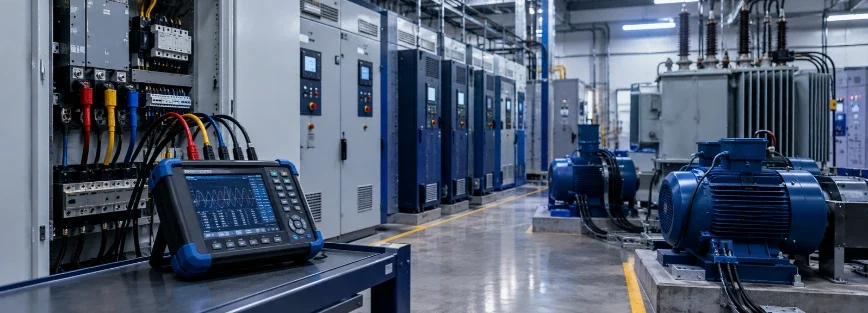
Unexplained equipment trips and unstable performance can point to an overlooked cause: poor power quality. Power Quality Analysis Services help industrial facilities identify electrical disturbances, evaluate system performance, and understand the causes behind equipment trips, instability, and reliability concerns across Saudi Arabia — particularly issues affecting motors, drives, automation systems, control equipment, and electrical distribution networks.
A power quality assessment provides engineers with the measurements and analysis needed to identify the actual electrical causes of recurring problems, helping facilities move beyond repeated equipment replacement and make informed decisions about reliability improvements and LV/MV electrical system improvements.
What is Power Quality Analysis?
Power quality analysis is the engineering process used to measure and evaluate the condition of electrical power supplied to equipment specifically, whether that power remains within acceptable operating characteristics.
In industrial environments, electrical systems must support continuous operation of:
- Motors.
- Variable frequency drives.
- PLC based automation systems.
- Industrial control equipment.
- Protection systems.
- Sensitive electronic devices.
Power quality analysis services involve collecting electrical data and interpreting it from an engineering perspective.
The objective is not only to identify that a problem exists, but also to determine:
- What caused the disturbance.
- Which equipment is affected.
- How frequently the issue occurs.
- What engineering actions may reduce the impact.
Common measurements during a power quality audit include:
- Voltage level variations.
- Current behavior.
- Harmonic distortion.
- Frequency stability.
- Voltage imbalance.
- Power factor.
- Electrical disturbance events.
For industrial facilities, this information supports preventive electrical maintenance and helps engineers understand system performance before implementing improvements.
Read About: Types of Power Quality Disturbances | Causes & Solutions
Why Do Industrial Facilities Need Power Quality Assessment?
Industrial facilities depend on reliable electrical systems because even short disturbances can interrupt processes and affect equipment operation.
Equipment Reliability
Poor power quality can contribute to stress on motors, transformers, drives, control panels, and electronic components. Repeated electrical disturbances may shorten equipment operating life and increase maintenance requirements.
Unexpected Shutdowns
Many industrial interruptions are not caused by complete power failures. Short voltage disturbances can trigger drive trips, controller resets, protection operations, and process interruptions. Power quality monitoring helps identify whether electrical disturbances are contributing to these events.
Production Continuity
Manufacturing plants, processing facilities, and utilities require stable electrical conditions to maintain continuous operation. A power quality investigation can support decisions related to:
- Equipment upgrades.
- Electrical expansion.
- Load changes.
- Reliability improvement.
Electrical Troubleshooting
raditional troubleshooting often focuses on the failed component. A deeper approach examines the electrical environment surrounding the equipment.
How Is the Assessment Process Performed?
A professional assessment normally follows a structured engineering process.
- Define the Electrical Issue: The first step is understanding the problem which equipment is affected, when the failure occurs, and whether the issue is continuous or intermittent.
- Review System Information: Engineers review available information such as electrical drawings, single-line diagrams, equipment specifications, and load information.
- Collect Operating Data: Data collection may include equipment operating conditions, maintenance records, and previous failure events.
- Monitor Electrical Parameters: Monitoring equipment can record voltage variations, current changes, harmonic levels, and disturbance events.
- Analyse Findings: Collected information is evaluated to determine root causes, risk areas, and improvement opportunities.
- Recommend Engineering Actions: Based on this analysis, engineers propose system adjustments, equipment improvements, and electrical design modifications.
What Does This Type of Analysis Measure?
key electrical parameters such as voltage, harmonics, power factor, frequency, and voltage imbalance each linked to a specific type of equipment stress, from overheating to reduced motor life. These measurements help engineers identify disturbances such as voltage sags, swells, and harmonic distortion, assess their potential impact on motors, drives, transformers, and other equipment, and determine whether electrical conditions are contributing to reliability problems.
The results are evaluated against applicable standards and operating limits to identify abnormal conditions and support appropriate corrective measures.
Standards and Grid Requirements: IEEE 519 and Saudi Grid Code
Power quality analysis uses recognized standards and grid requirements to determine whether measured electrical conditions fall within acceptable limits. IEEE 519 provides requirements and recommended limits for harmonic voltage and current distortion at the Point of Common Coupling (PCC), particularly for systems with non-linear loads.
For facilities in Saudi Arabia, the Saudi Arabian Grid Code sets additional requirements for connection to the transmission system, including limits on voltage variations and harmonic distortion. During a power quality analysis, engineers evaluate recorded measurements against the applicable requirements to identify deviations and determine whether further investigation or corrective action is required.
Power Quality in Mining and Steel Facilities
Mining and steel facilities rely on large motors, crushers, conveyors, and high-power VFDs that operate under demanding and often variable load conditions. These electrical environments can be affected by voltage sags, harmonic distortion, power factor issues, and other power quality disturbances.
Even brief electrical disturbances can interrupt production or trigger protective trips on critical equipment, resulting in unplanned downtime. Power quality analysis helps engineers determine whether electrical conditions are contributing to recurring equipment problems and supports more informed maintenance and reliability decisions across mining and steel operations in Saudi Arabia.
How It Helps Reduce Equipment Failures and Downtime?
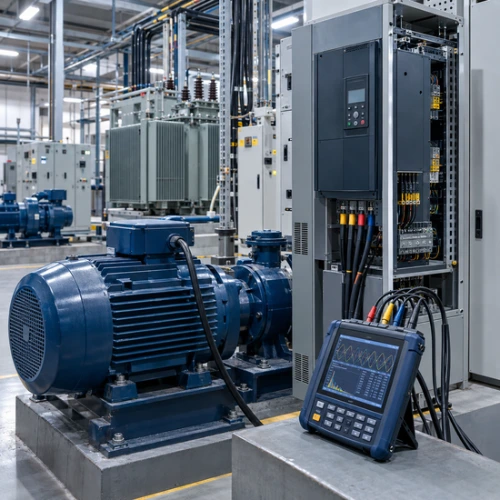
Not every equipment failure is mechanical, even when it looks that way. A motor bearing fails, a drive trips repeatedly, or a transformer runs hotter than expected and the natural response is to replace the component and move on. But when similar failures continue across different units or production lines, the electrical conditions surrounding the equipment should also be investigated.
Two power quality conditions can contribute to this pattern:
- Harmonic distortion: can increase electrical losses and heating in motors and transformers, contributing to insulation stress and premature deterioration over time.
- Repeated voltage sags and swells: may place additional stress on drives and control systems, particularly when disturbances occur repeatedly.
By the time a component fails, the electrical disturbance that contributed to the problem may have already passed. A structured assessment changes the starting point of the investigation instead of focusing only on what failed, engineers can examine voltage behavior, harmonic levels, and disturbance events over time to determine whether electrical conditions are contributing to the problem.
That shift can improve maintenance decisions:
- Potential electrical causes can be addressed through appropriate measures such as filtering, load changes, or equipment upgrades, where required.
- Maintenance becomes more data-driven, using measured electrical conditions rather than relying only on repeated component replacement.
- Recurring equipment problems become easier to investigate, helping maintenance teams identify patterns before they lead to further failures.
The result is not just fewer repeated repairs, but better visibility into equipment reliability, more informed maintenance decisions, and potentially fewer unplanned shutdowns.
Common Mistakes When Managing Power Quality Problems
Treating Symptoms Only
Replacing a burned-out drive or a tripped breaker fixes the outcome, not the cause. If the electrical environment that damaged it hasn’t changed, the replacement is simply next in line.
Ignoring Harmonic Problems
Harmonic distortion works silently — it doesn’t trip a breaker on day one. It accumulates as heat inside motors and transformers, until a facility that “never had power quality issues” suddenly has an equipment failure it can’t explain.
Lack of Monitoring
Intermittent disturbances rarely repeat on command. Without continuous electrical data, an engineer investigating a one-time trip is left chasing a problem that has already disappeared.
Poor Documentation
A single failure looks random. Ten similar failures over two years, undocumented, still look random — even though they’re telling the same story every time.
Why RETQAN’s Power Quality Analysis Services?
Diagnosing a power quality issue is only useful if the findings can be acted on. RETQAN combines engineering-level electrical diagnostics with direct partnership access to ABB, Siemens, Danfoss, and Vacon equipment allowing recommendations to translate into practical corrective actions, whether that involves drive reconfiguration, filtering solutions, protection coordination, or equipment retrofit.
This combination of diagnosis and implementation is particularly relevant for mining, steel, and utility facilities across Saudi Arabia, where unplanned downtime carries a significant operational cost and where equipment reliability depends on more than routine maintenance alone.
Faq
How long does a power quality analysis take?
Duration depends on the size of the facility and the nature of the issue being investigated. Most assessments involve an initial review of the electrical system followed by a monitoring period long enough to capture normal operating conditions and any intermittent disturbances.
Do I need to shut down my facility during a power quality analysis?
No. Monitoring equipment is typically installed while the facility continues normal operation, since the goal is to observe actual operating conditions rather than a simulated or idle state.
How often should a power quality analysis be performed?
There is no single fixed interval that applies to every facility. Many industrial sites schedule periodic assessments as part of routine electrical maintenance, or request one following equipment upgrades, expansions, or a noticeable increase in electrical disturbances.