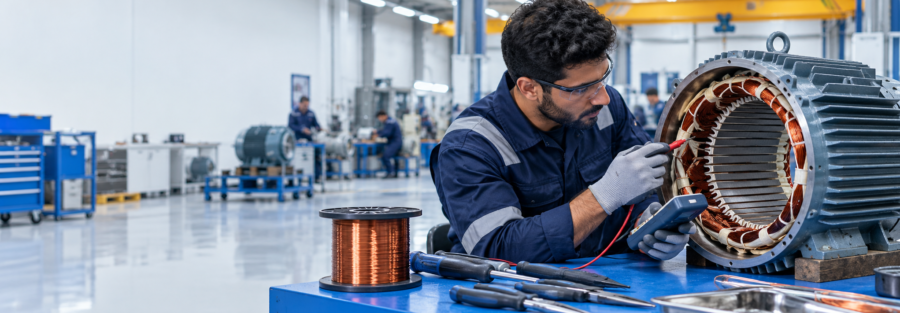
This Saudi-based rotating-equipment support provider supplies, tests, rewinds, balances, and maintains industrial motors across the Kingdom for plant and utility applications. For sites evaluating electric motor rewinding Saudi Arabia support, the safest approach is to start with inspection, testing, repair-scope control, and documented repair practice before deciding whether the motor should be rewound, repaired differently, or replaced. The main industry repair reference, ANSI/EASA AR100-2025, exists specifically to set recommended practices for the rewinding and rebuilding of rotating electrical apparatus, including record keeping, tests, and analysis.
That matters because rewinding is not just “replace the copper and restart the motor.” EASA states that proper rebuilding practice should preserve motor efficiency and reliability when done correctly, while Fluke notes that winding insulation breakdown and bearing wear are among the most common motor-failure patterns and that both usually develop from identifiable causes before total failure occurs.
What to check before sending a motor for rewinding?
The first checkpoint is whether the failure is really in the stator winding. A motor may trip, overheat, vibrate, or lose torque because of bearings, alignment, supply quality, contamination, load issues, or converter-related stress rather than because a rewind is automatically required. Fluke’s guidance is explicit that motor failure causes are both electrical and mechanical, and that different failure modes need different diagnostic paths.
Before approving a rewind, a plant team should usually check:
- insulation condition and winding-to-ground condition
- bearing condition and vibration behavior
- signs of overheating, contamination, or moisture
- supply or drive-related stress
- motor nameplate data and duty history
- whether the motor is mains-fed or converter-fed.
That last point matters more than many buyers expect. IEC TS 60034-25:2022 is an application guide for AC electrical machines used in power drive systems and specifically addresses the interactions between the electrical machine and the converter, including installation guidance as part of a power drive system. So if the motor is operating with a drive, the repair decision should be reviewed together with the drive application, not separately.
For that reason, it often makes sense to review industrial electric motors together with variable frequency drives and VSDs when the motor is part of a speed-controlled system.

Common issues that lead plants to request rewinding
Winding insulation deterioration
Fluke notes that insulation deteriorates over time and with use, and that damaged insulation leads to current leakage and added wear on the motor. That makes insulation aging one of the clearest reasons to investigate rewinding, especially when testing shows a declining trend rather than a one-time anomaly.
Repeated overheating
Persistent overheating is often a warning that the winding system, cooling path, or load condition has already been compromised. Fluke lists multiple causes of winding stress, including transient voltage and insulation breakdown, which means overheating should be treated as a root-cause question, not just a symptom.
Bearing-related damage that spreads into winding damage
Bearing wear is one of the most common motor-failure patterns identified by Fluke. When bearing problems are left unresolved, they can increase heat and vibration and eventually contribute to wider motor damage. In those cases, a rewind may be only part of the repair scope, not the whole answer.
Moisture, contamination, and poor maintenance history
Fluke’s insulation-testing guidance explains that periodic testing helps reveal deterioration over time and allows plants to schedule service before total failure. That is especially important for harsh industrial sites where moisture, dirt, and aging insulation are allowed to accumulate without trending or planned testing.
What a proper rewinding decision should include
A proper rewinding decision should be based on test data, machine condition, and repair objectives. EASA’s AR100 standard says its scope includes record keeping, tests, analysis, and general repair guidance. EASA’s motor-efficiency guidance also says repair centers should comply with AR100 and follow the documented do’s and don’ts if the goal is to retain motor efficiency after rewinding.
That means a professional review should answer questions like these:
- Is the stator actually the failed element?
- Are bearings, shaft condition, balance, or rotor issues also involved?
- Is the motor economically and technically suitable for rewind?
- Will the motor return to a drive-fed duty that needs converter-duty review?
- What tests will be documented before and after repair?
This is where service scope matters more than a quick workshop decision. The referenced motor page states support for electrical tests, on-site overhauling, rewinding, test-bench work, annual maintenance contracts, and both LV and MV motor support up to 8 MW. That kind of scope is more useful than rewind-only support because it lets the plant treat the motor problem as a system problem, not a single workshop task.
Risk indicators that mean the job should go to a specialist team
Some cases should not be handled as routine rewind jobs. A specialist team is usually justified when:
- insulation values are deteriorating across time, not just once
- vibration or bearing evidence suggests more than winding damage
- the motor is critical to production or difficult to replace quickly
- the motor operates on a VFD or other converter-fed system
- previous rewinds or repairs did not solve the problem
- the plant lacks trusted as-left test records or repair history.
A converter-fed motor deserves special caution. IEC TS 60034-25 makes clear that converter-fed machines involve interface and installation considerations between the motor and the converter. So when rewinding a motor that operates with a VFD, the plant should also review the connected drive, cable arrangement, and application duty. Relevant supporting pages include how to select a VFD for a motor, VFD preventive maintenance checklist, and what causes a VFD to trip.
When to rewind and when to step back and reassess
Rewinding makes sense when testing and inspection support it, when the repair path follows recognized practice, and when the machine remains a good candidate for return to service. EASA’s repair guidance exists because good rewinding practice is a controlled engineering process, not a shortcut. EASA also says that proper rebuilding practice can retain motor efficiency when the work follows the right procedures.
But the plant should reassess before rewinding when the failure may actually be caused by supply quality, load problems, bearing-related damage, or drive-related stress. Fluke’s failure guidance is useful here because it frames motor problems as multi-cause problems, not winding-only problems.
A practical service-first path for Saudi facilities
A practical sequence usually looks like this:
- Test insulation and record the actual condition.
- Inspect bearings, vibration, heat, and contamination evidence.
- Confirm whether the motor is mains-fed or converter-fed.
- Decide whether rewinding alone is enough or whether balancing, bearing work, or drive-side review is also needed.
- Send the job to a repair team that follows documented repair practice and issues post-repair records.
That approach is usually safer than moving straight to a rewind order without a diagnostic checkpoint.
FAQ about electric motor rewinding Saudi Arabia
What should be checked before approving electric motor rewinding?
Check insulation condition, bearing condition, vibration, overheating evidence, contamination, and whether the motor operates on a converter-fed system. Those checks help confirm whether rewinding is actually the right repair path.
Can rewinding preserve motor efficiency?
Yes, when proper repair practice is followed. EASA says service centers can retain motor efficiency during rebuilding and strongly recommends compliance with ANSI/EASA AR100 for rewinding and rebuilding work.
Why should a VFD-fed motor be reviewed differently?
Because IEC TS 60034-25 specifically addresses the interaction between converter-fed motors and the converter, including installation guidance as part of the power drive system.
When should a plant call a specialist team instead of treating it as a normal repair?
When the failure is repeated, the motor is critical, the root cause is unclear, the machine is converter-fed, or there are signs that bearings, vibration, or load issues are involved alongside winding damage.
If your facility needs electric motor rewinding Saudi Arabia teams can trust for assessment, rewinding, balancing, or maintenance support, start with industrial electric motors, review any connected drive duty through variable frequency drives and VSDs, and use contact us to book a motor assessment and request a quotation.